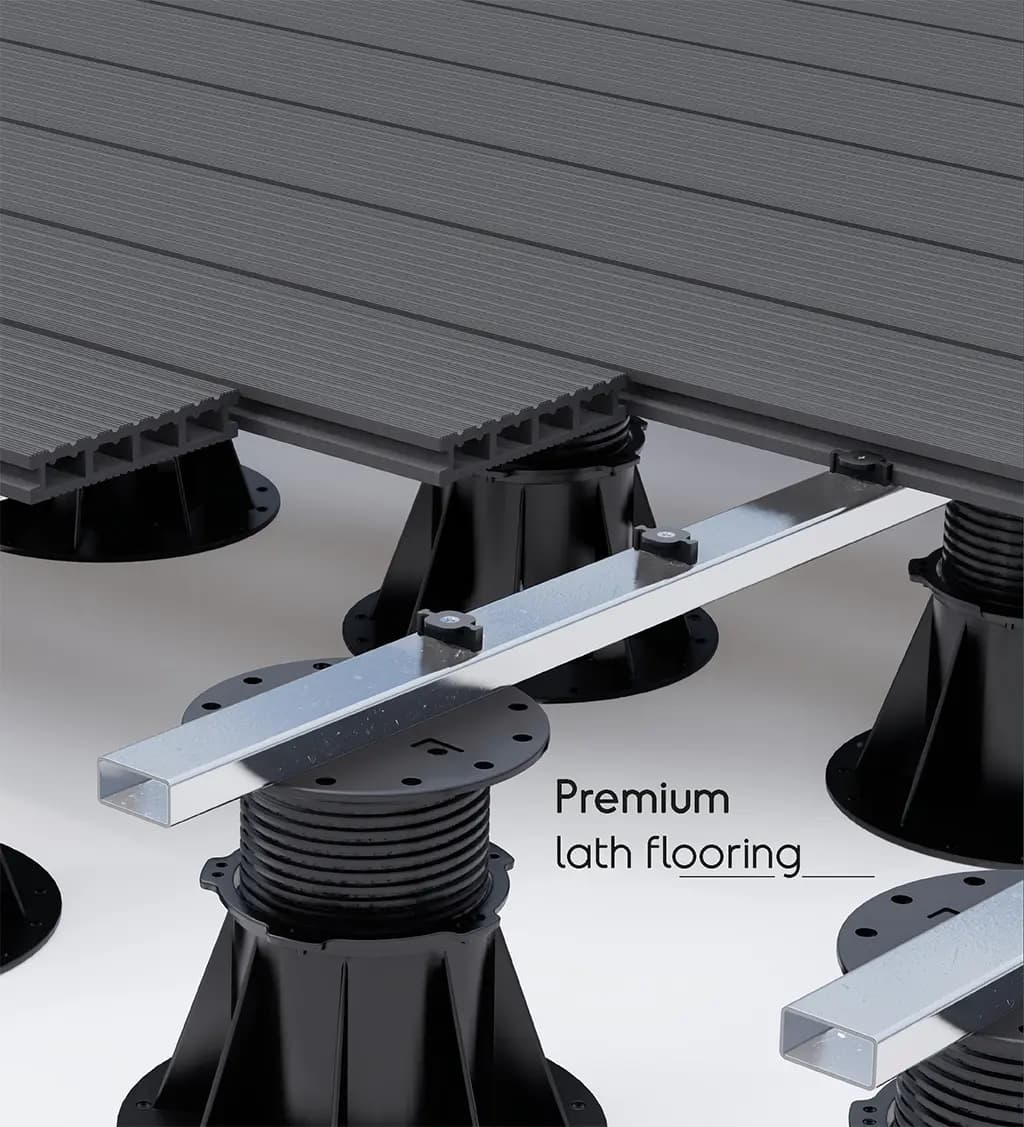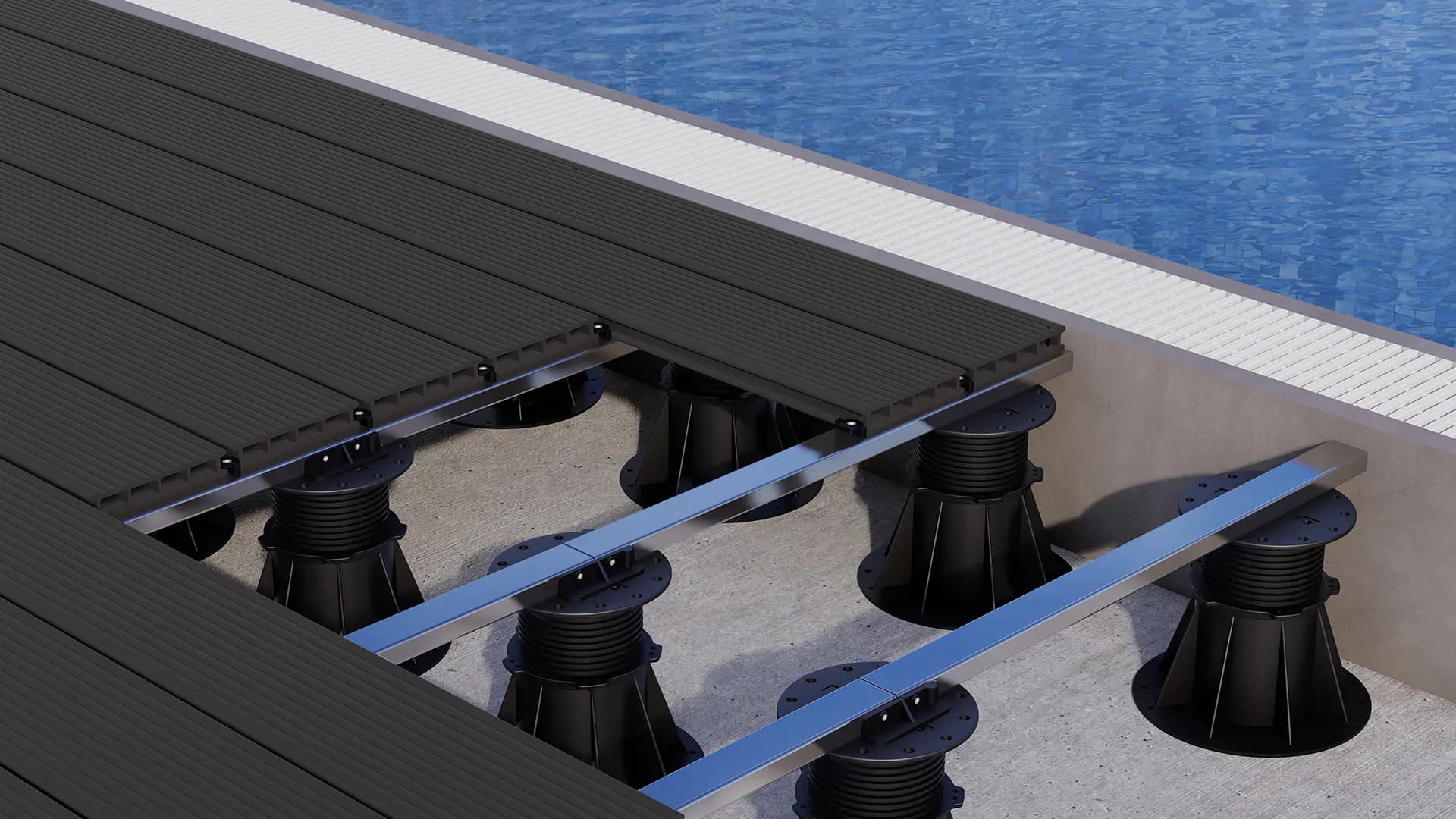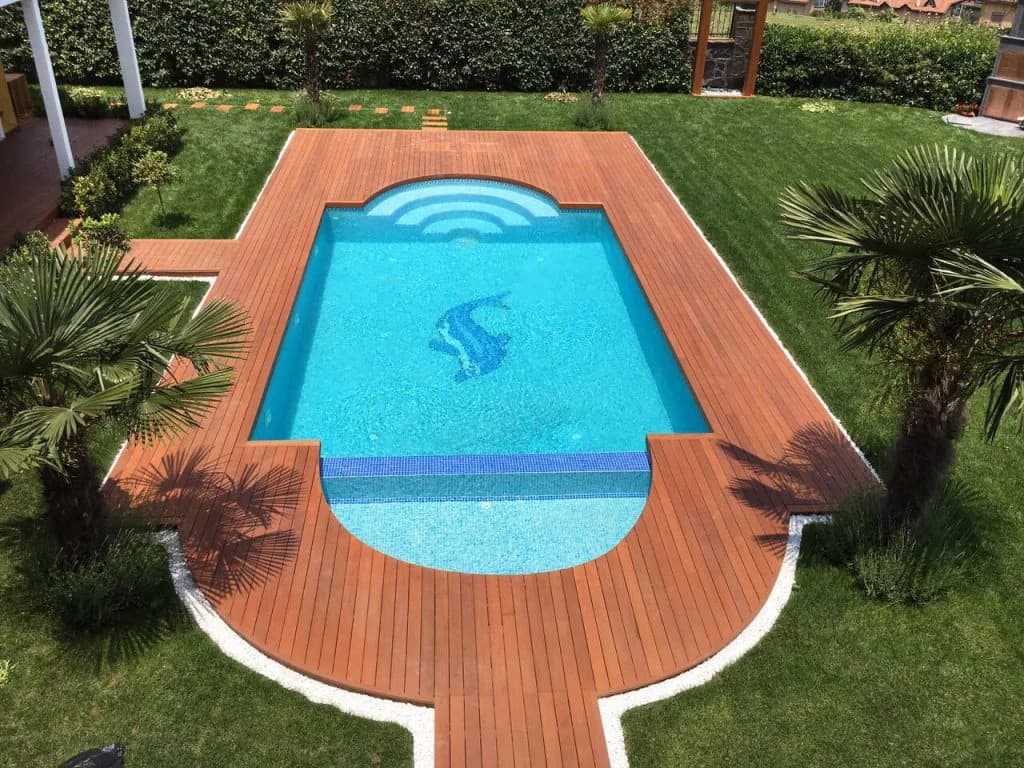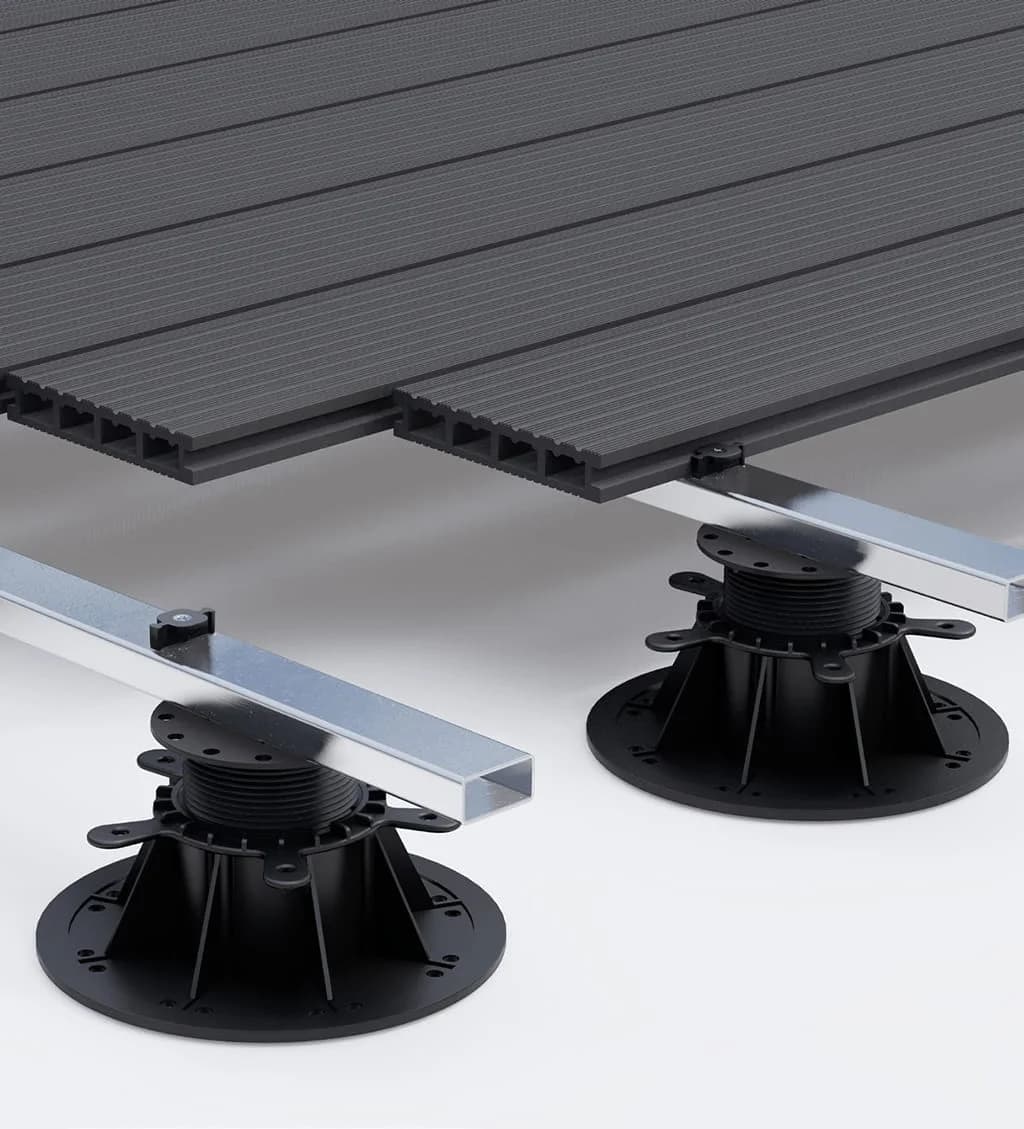
Terrace pedestals are Tokoz units pressed in Çorlu. On one terrace the slab falls are read first, the pads go down, and each unit is brought to a single finished plane before the finish and the load family are fixed.
Work on one terrace does not open with a part code. It opens on the falls of the concrete slab that is already there. The slab is walked from the high edge to the low corner and the marks are made before any pedestal is carried up. A door threshold, the top of the parapet and the lowest point of the slab are read on the same pass. The plane people will walk on has to clear the threshold and still leave the slab's own fall as the path water already takes. That finished plane is not the slab. The slab may keep its fall. The walking surface is drawn only after the marks are on a sheet. Copying a height out of a catalogue skips this reading. After a skipped reading every pedestal starts chasing a number the slab never offered. A second terrace on the same building is read on its own. Its threshold and its low corner do not belong to this terrace. No pad goes down and no screw is turned until the marks are on the sheet. The sheet holds only the highs and the lows of this terrace. It does not yet name a load family and it is not a list of codes to buy. If the low corner and the threshold cannot both be kept, the threshold is settled first and the plane is drawn again. Only then is the surface of the next step understood. The person who will turn the screws is not asked to invent the falls from memory. A step, a drain position or a break in level inside the terrace is marked on the same sheet as the place where the reading pauses. One terrace keeps one set of falls, written once. Nothing is stood on the slab until that writing is finished. The reading is done in daylight on the slab itself, not from a photograph taken on another day.
The T-P pad goes down before the screw is turned
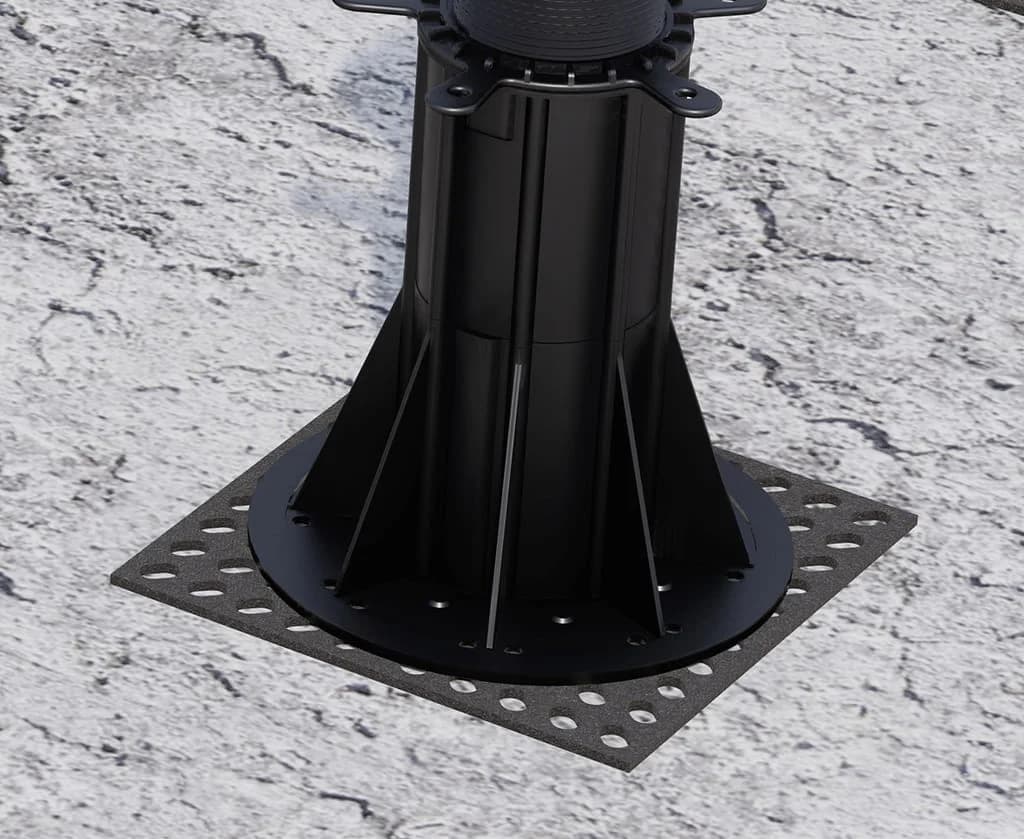
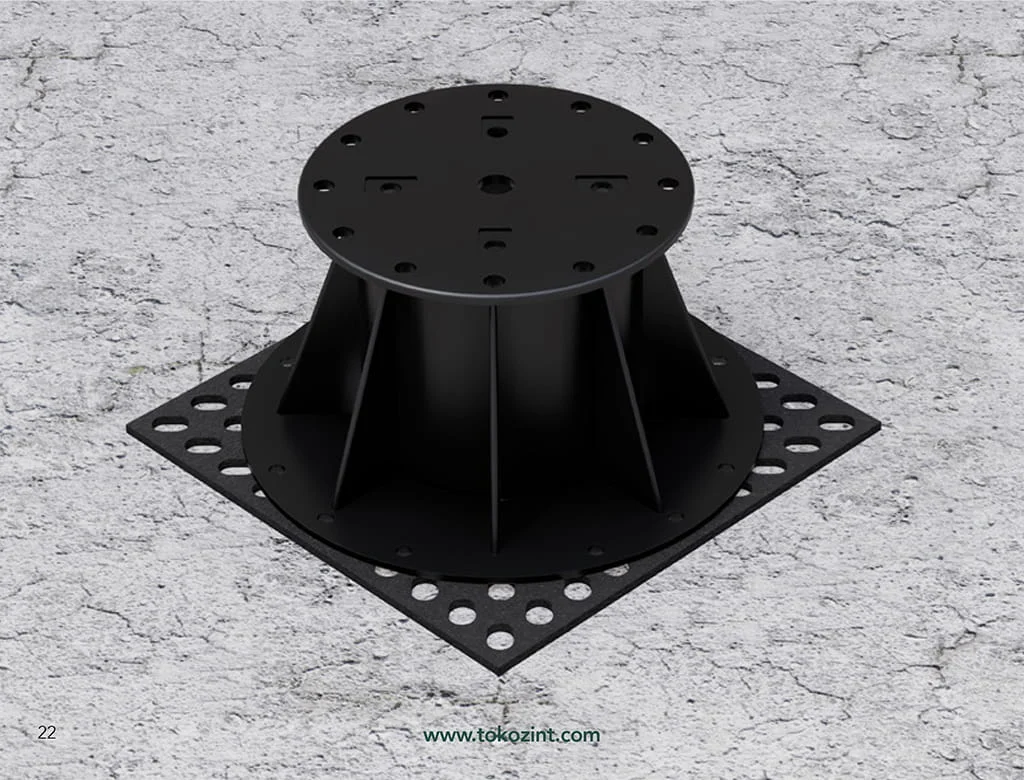
When the fall sheet is in place, the next job is not chasing height. The next job is the T-P pad that goes under every pedestal. On this terrace T-P is only this: the pad that goes down on the slab before the screw is turned. If the screw is turned before the pad is seated, the height is read from a different bearing. That bearing is not the surface marked on the sheet. Every point on this terrace sees the same order. The pad goes down first, the pad sits against the slab, the pedestal stands on the pad, and only then is the screw discussed. The pad is not a tool for finding the finished plane. The plane is the work of a later step. Leaving the pad in the box and turning the screw first breaks the order of this terrace. In a broken order two neighbouring pedestals look as if they share the sheet, while one stands on a pad and the other does not. The one without a pad bites the slab on a small bump at a single point. When the plane is built, that pedestal gives a lip different from its neighbour. If a pad is worn, the body is not thrown away. The worn pad is replaced before any height is accepted. A missing pad is under the same rule. A point is not left bare and finished later. Finishing later is not a trim added after the plane is done. The count of pads is kept with the count of pedestals, because the pad goes down before each one. A spare pad from another terrace is not written onto this sheet. The sheet marks which point has received its pad. A point without that mark is not ready for a screw to be turned. Nobody starts bringing a pedestal to a finished level before this step is closed.
T-SC is only for a fall the screw should not hide
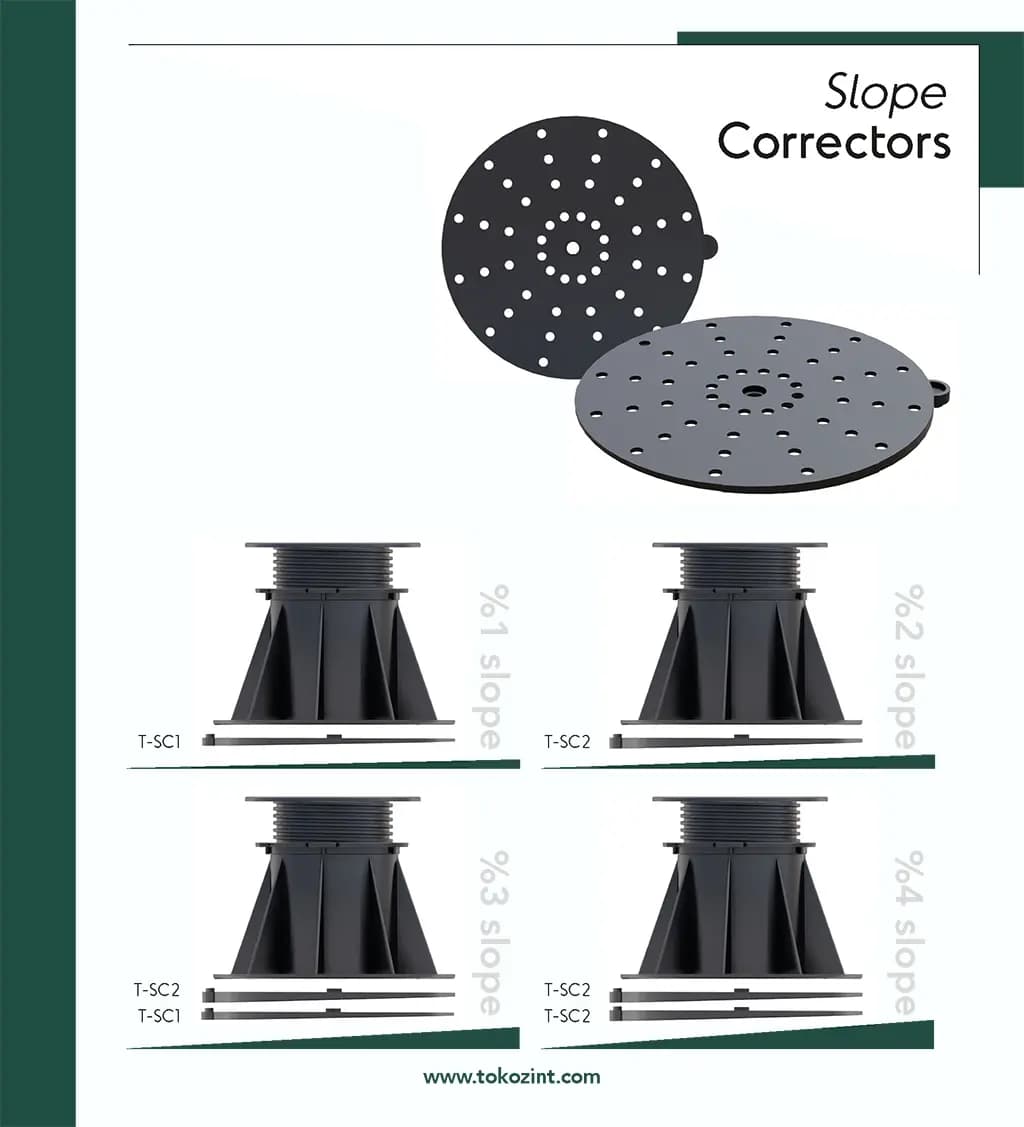
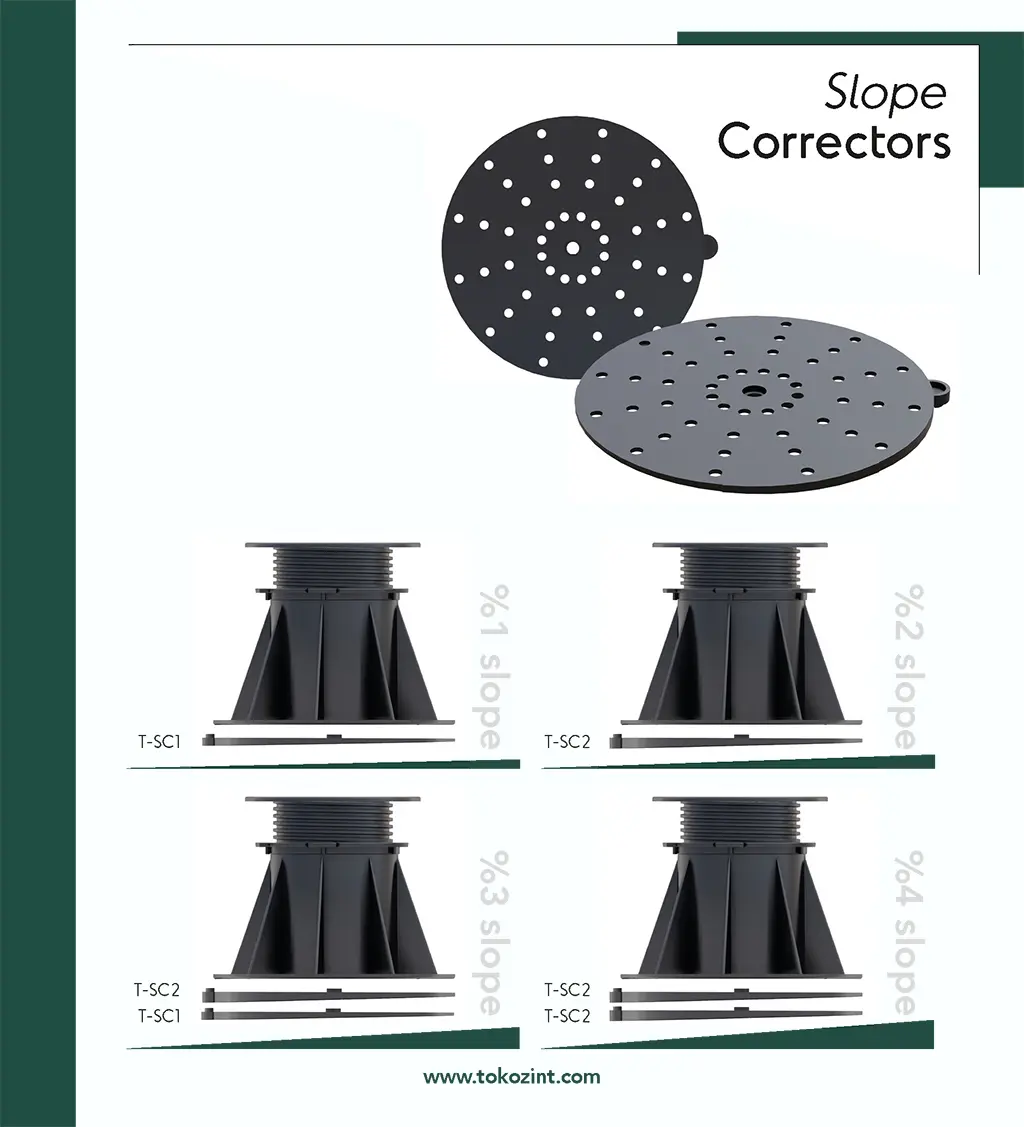
After the pads are down, a slope piece is not written under every point by habit. On this terrace T-SC is only this: the piece of 1 to 2 percent used when the fall of the slab is larger than the screw should hide. The piece goes to the points where the fall sheet still shows a steep fall. It does not go to a point where the fall is small enough that the screw can reach one plane without swallowing that fall. Hiding a steep fall inside the screw tilts the finished plane, or it sets the walking surface against the path water already takes on the slab. That fight is not settled by adding another turn of the screw. It is settled by putting T-SC under that point and leaving the screw to the plane alone. T-SC does not take the place of the pad. The pad still goes down first. The piece enters between the pad and the pedestal where the fall is large. The gentle side of the terrace may never see the piece. The steep side may. Treating both sides as the same duty is emptying the box onto the slab. The count of pieces comes from the steep points on the fall sheet. It is not a copy of the pedestal count. If a point later proves to have a small fall, the piece comes back off and the screw meets the plane there on its own. Putting the piece on top of every pedestal, inside the finish, is not the work of this step. The piece is decided at the base, before the screw is turned. The decision is not made while height is being chased. It is made from the high and low marks on the first sheet. If those marks are missing, the piece is missing too. The move to the plane does not start until this split is written.
Each pedestal is brought to one finished plane
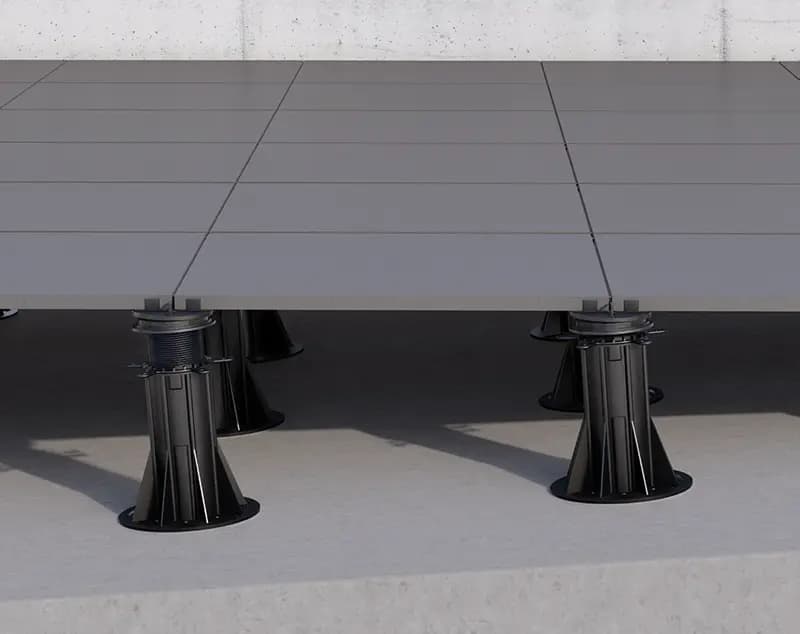
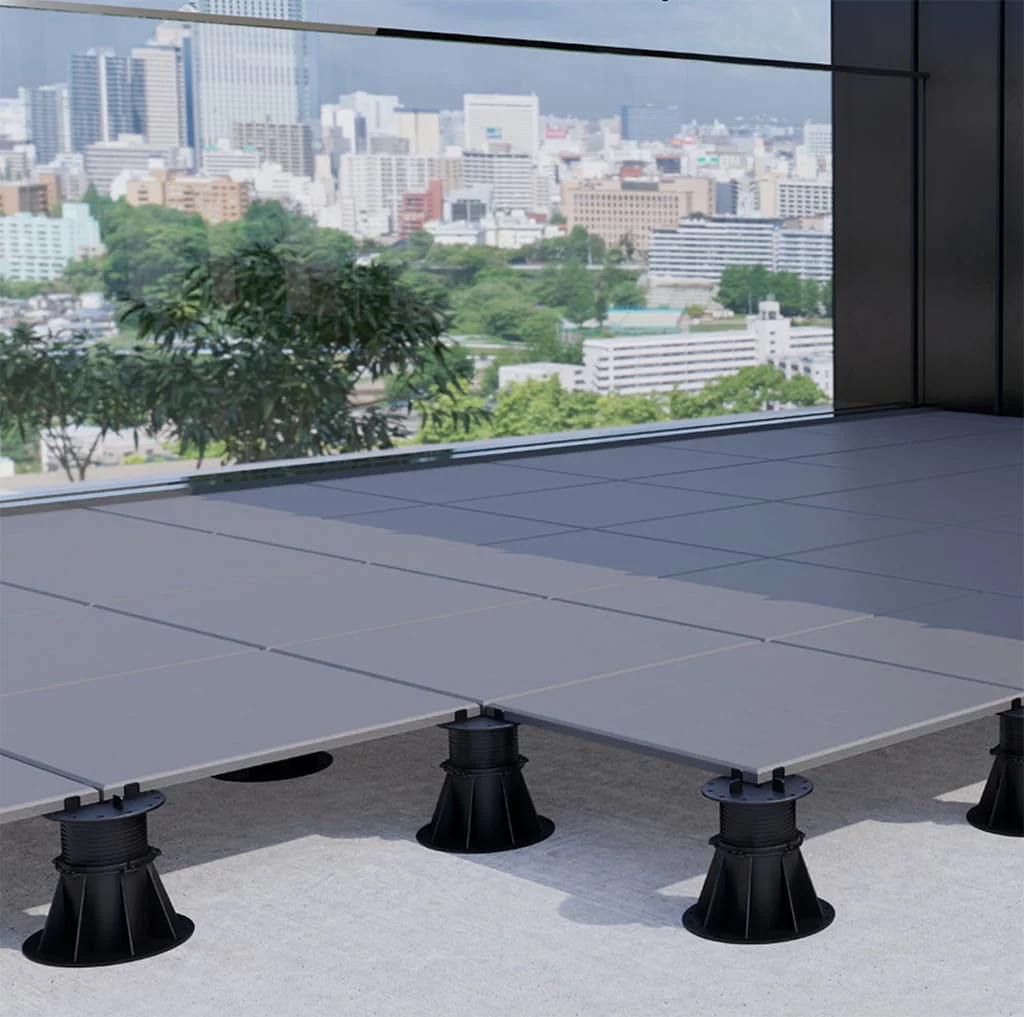
Once the pads are seated and T-SC is in place only where it belongs, each pedestal height is brought to one finished plane. The plane is the surface this terrace will be walked on. Neighbouring screws do not have to show the same millimetre. The aim is that every head meets the same plane. The slab may want a long screw in the low corner and a short screw on the high ridge. A different length does not mean the plane has broken. It means the slab falls and the plane above it is one. Treating equal screw length as a rule tilts the plane on a falling slab. A tilted plane rubs the door at the threshold or drops away toward the parapet. The check is to hold the plane in one place and turn each pedestal until it meets that plane. A pedestal that misses is turned again. If turning is not enough, its pad has shifted or T-SC is on the wrong point. The bearing is put right first. Then the screw. The plane is built before the finish is chosen. Tile, joist and deck will all land on this plane afterwards. Tilting the plane to suit a finish reverses the order. The threshold is the upper limit of the plane. If the plane climbs above the threshold, the door will not work. If the plane falls away under the parapet, the edge goes empty. Those two limits stand together with the marks on the first sheet. A pedestal pulled to a level outside those limits does not belong to the plane of this terrace. The plane is one across the whole terrace. Leaving one corner on another plane makes the edge of a plate step at that corner. When this step closes, the finish has not been chosen yet. The choice can be made because the plane is standing.
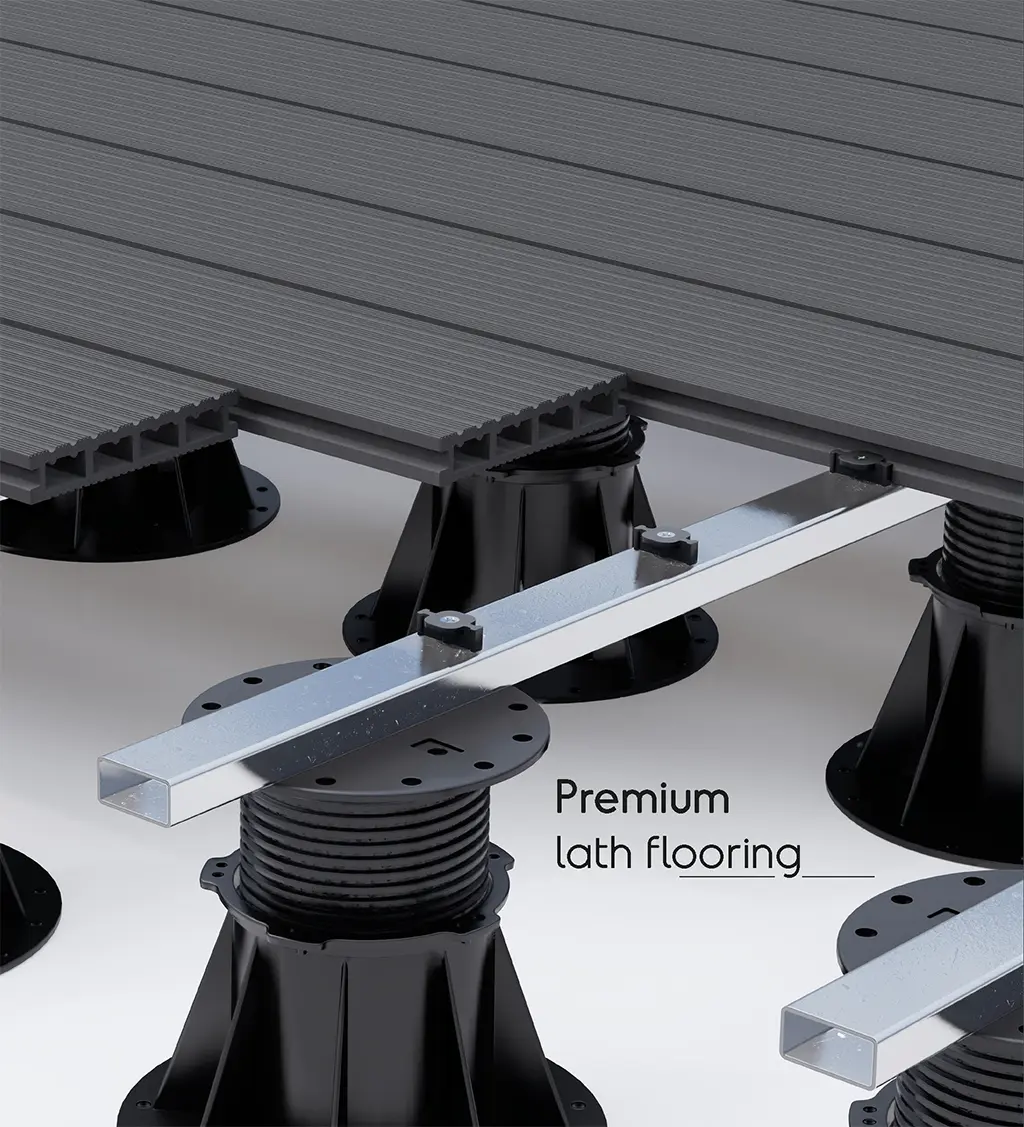
The finish is chosen once: tile, joist or deck
When the plane is standing, the finish is chosen, and on this terrace that choice stays. The choice is one of three: tile, joist or deck. Tile is the finish that seats the edge of a plate on a head. A joist is the path that carries the batten the finish will run on. Deck is the path that holds the edge of a board with its own clip. All three land on the same plane. They do not share the same head. Leaving tile on half the terrace and deck on the other half does not bring a plate edge and a board edge to one shared seat. The edge steps there, or it hangs with nothing under it. This page is not a breakdown of the parts of those three paths. What is said is this. After the plane is built, one path is chosen and the terrace stays on that path. Changing halfway makes the plane be discussed again. A plane discussed again is measured again against the threshold and the parapet. If the measure does not hold, the change is not written as a patch on this terrace. The change is handled as a second terrace with its own fall sheet. The load family is not chosen before the finish. The family is the family of the pedestals that go under that finish. The name of the finish stands on the order apart from the length of the pedestal. The length comes from the plane. The name comes from the path chosen in this step. If tile is chosen, a joist layout is not written on this sheet. If joist is chosen, a tile size is not written. If deck is chosen, a tile joint is not written. A wrong name wastes a correct plane. A correct plane is still one plane under the wrong finish, but the edges do not sit to each other. The choice is written on the sheet as one word, and that word does not change until the terrace is finished.
Premium stays one family at a 1000 kg point
Once the finish is chosen, the terrace stays in one load family. In the Premium family the declaration is a 1000 kg point on one pedestal. That number is not the load of the whole terrace. The whole is shared by the pedestals on the layout. The point is what one pedestal is declared to carry. If Premium is chosen, every pedestal on this terrace is Premium. The choice is made before the plates come down. Turning one corner to another family after the plates are down makes the edge of a plate at that corner sit differently from its neighbour. The family is written together with the finish. Tile, joist and deck can all land on the Premium family. The finish that lands does not change the family. What changes the family is adding a second body type to the same sheet. A line of planters, the swing of a door or a load at the edge stays on a Premium pedestal if Premium was chosen. A strip that looks light is not a reason to drop the family. Dropping it draws a line across the terrace, and on that line the edge of a plate does not sit on one lip. On the order the family is a line of its own, apart from the finish name and the pedestal length. The line is written once. A second line belongs to a second terrace. This page is not a brochure of the family. What is said is the step in the order: when the finish stands, the family stands, and the family does not change until the terrace is finished. The 1000 kg is not read as a wind figure or a rain flow. The reading is the declaration of one point. The declaration is the declaration of the pedestal that built the plane.
A 500 kg Clever jack does not share this terrace
Clever is another family. In that family the declaration is a jack of 500 kg. The jack is not a short Premium. It is not a spare dropped into the light corner of the same terrace. Mixing Premium and Clever on one terrace changes how the edge of a plate sits. If a plate bears on a Premium head on one side and on a Clever jack on the other, it does not share one lip with the next plate. The edge stays high on one side, or it rocks. The plane that was built stops being the plane the plates share. That difference is not wiped out by another turn of a screw. To clear it, the mixed jack leaves this terrace and a pedestal of the same family takes its place. If Clever is wanted, that want does not enter this terrace's sheet as a patch. It is written as a neighbouring terrace with its own falls, its own pads and its own plane. The neighbour may stay in the 500 kg family. If this terrace opened on Premium, it closes on Premium. The mix is not justified as a saving that occurs to someone after the finish is chosen. The reason breaks the edge of a plate. When the edge is broken, the plane at the threshold is no longer secure either. The plane was built on heads of one family. When one head is from another family, the support of the plane at that point changes. The changed support splits the single plane of the first sheet into two. A plane split in two is work outside the order of this terrace. The order keeps to one family after this step as well.
The order is written from this sequence alone
The order is written only after the sequence is finished on the sheet. On the sheet the falls come first, then the pads, then T-SC only on the steep points, then one plane, then one finish, then one family. The count of pedestals is the count of points on this terrace's layout. The count of pads goes with the count of pedestals, because the pad goes down before every point. The count of T-SC comes from the points where the fall was not left for the screw to hide. The name of the finish sets the line. The name of the family sets the body. If a second family is on the same sheet, the order goes back. If a second finish name is on it, that goes back too. A sheet that comes back is not completed as a missing code. The sequence is read again. This page does not write a rain flow, a wind pressure or a slip class. What is written is the sequence of one terrace. The pedestals that the finished sheet asks for are pressed at the factory in Çorlu. The count comes from the layout. It is not a copy of a page in a catalogue. If the door threshold still does not hold, the sheet is corrected, not the factory. The corrected sheet carries the same sequence again. An order written by skipping the sequence makes the site build the plane a second time. A plane built a second time puts the pads that went down and the family that was chosen in doubt. The doubt shows at the edge of a plate. The edge does not sit on the same lip as its neighbour. For that reason the order is the last sentence of the sequence. It is not the first.