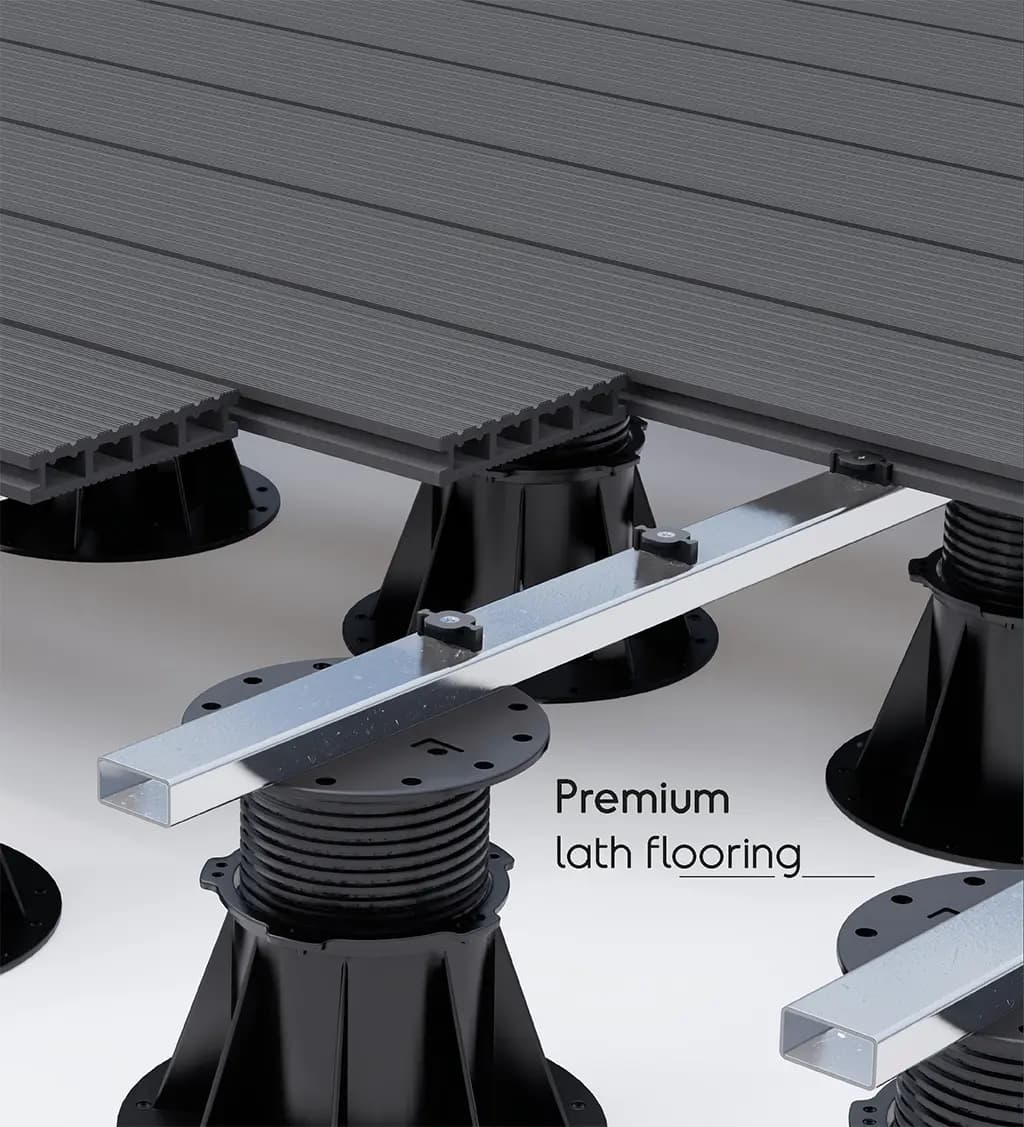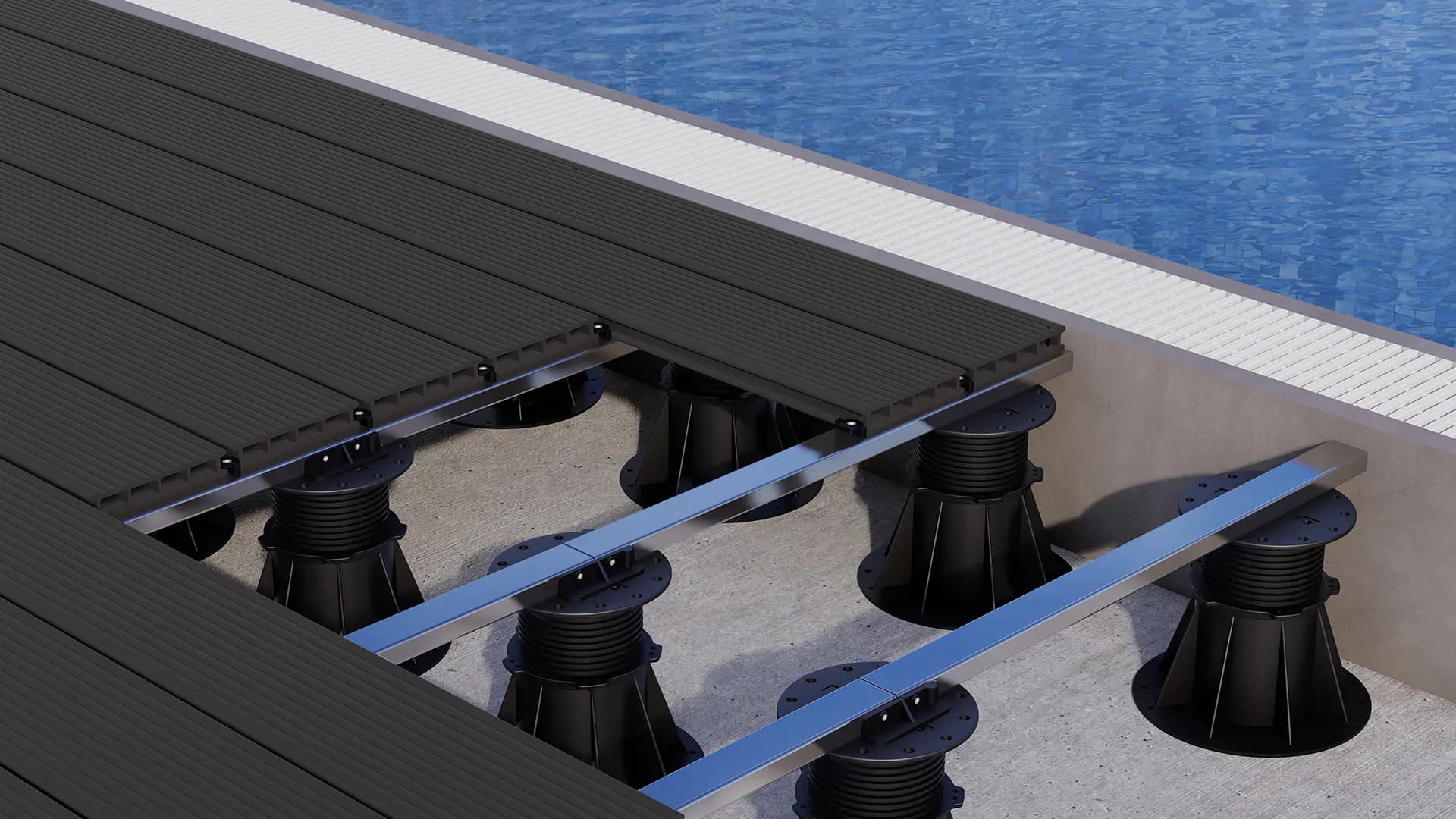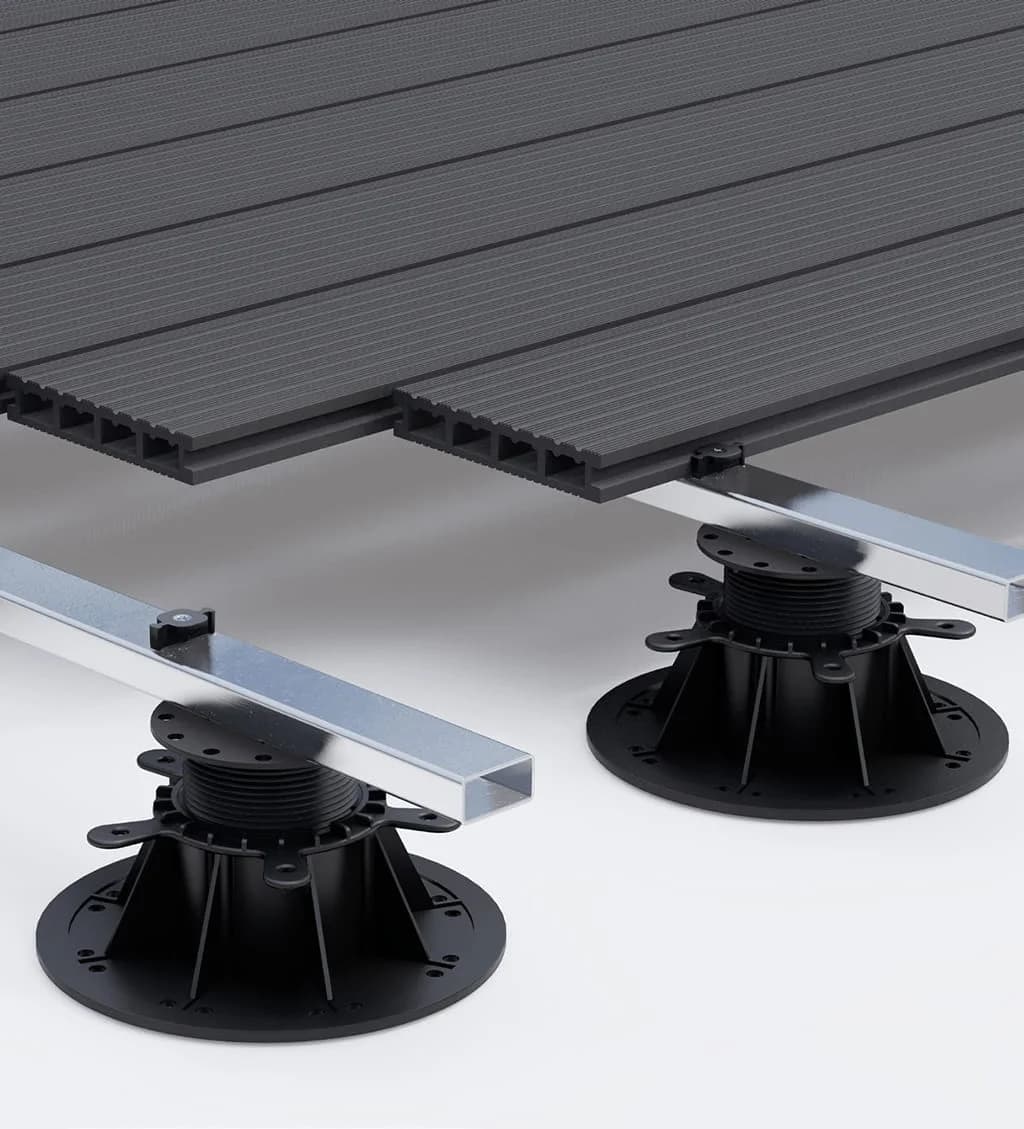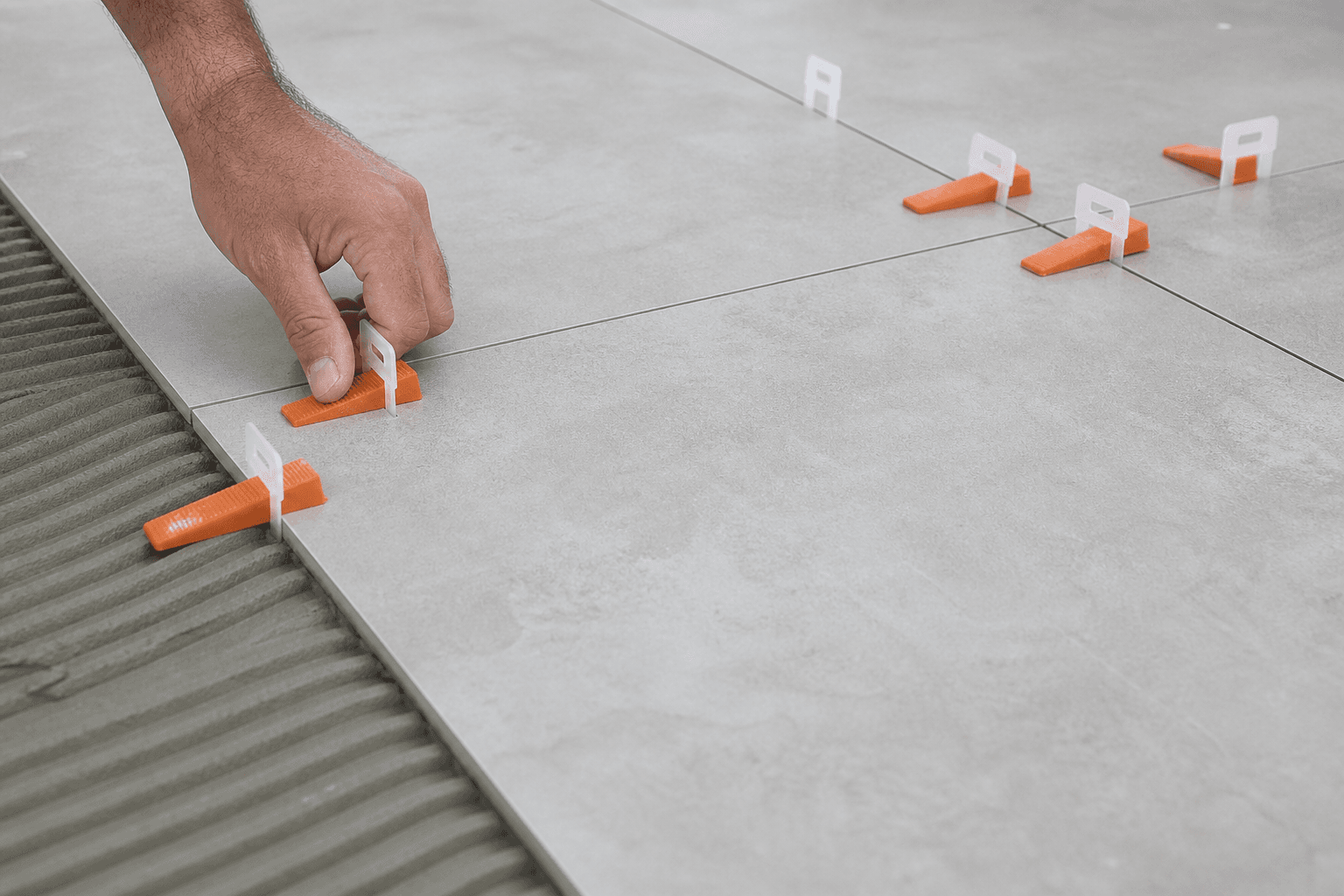
Floating-floor jacks are Clever units pressed in Çorlu. The finish is not glued and is not bedded in screed, so a piece can lift off and be set again on the same jack. The stated point starts at 500 kg.
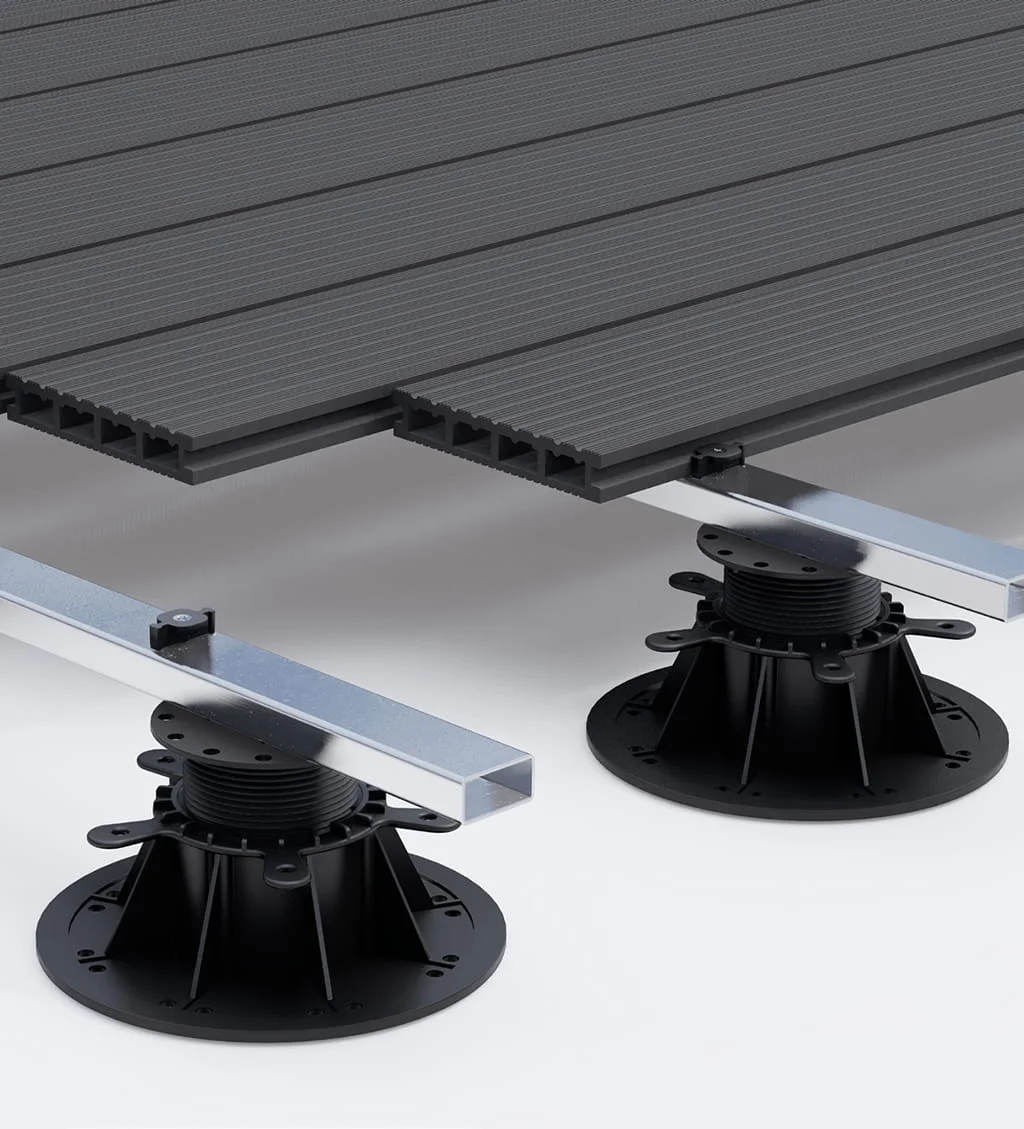
Floating-floor jacks, in this text, do not describe a finish buried in mortar. Glue does not enter the recipe either. A tile or a batten rests on the head of a Clever jack and does not stick to the waterproof sheet below. If glue were there, lifting one piece would pull its neighbour off too. Here the piece comes away alone. Coming away alone does not mean it rattles in its seat. The head has a seat, and the piece goes down into that seat. There is no screed underneath to chip out. The screed was not a forgotten layer. The method refuses screed from the start, because a buried piece cannot be put back at the same level. The floor is built loose on the first day so a later visit can set it again. Pouring a second concrete height on top would shift the door sill and the underside of the rail. This text does not reopen the sill. The jack is not a lump of mortar given a plastic shape. The jack is the point the piece returns to every time. Walking on it does not turn the loose build into a bonded slab. If a crew later pours screed over the sheet, this floor has ended and the writing has started to describe another job. The name on the order follows the loose method, not a colour card. A recipe that starts with a trowel lives on another page. What stays here is the unglued piece and the jack under it. Coming back into the seat at the same thickness is how the floor returns to the same level. If the seat of the head is still sound, the piece sits the second time the way it sat the first time. Loose is not a snag note. Loose is the name of the decision to take a piece off without breaking it and to put it in the same place.
A piece lifts and is put back at the same level
Lifting is not a demolition. One tile or one batten comes off while its neighbours stay. The piece that came off goes back into the seat of the same head, at the same thickness. What the seat remembers is the level. Turning the screw changes the height. Putting the piece back does not change the height. Dust under the piece is wiped, not scraped with a chisel. A cracked piece is swapped for a sound piece of the same thickness. The field is not rolled up like one carpet. The sitting mark on the head shows where the piece stood. That mark is not a factory return. The mark is a place note read on site. Spreading glue under the piece to hold it ends the loose method at that spot. If glue is offered as a bed against a fear of wind, the floor can no longer lift. If the piece rocks, the fault is not the freedom. The fault is that the head is not fully in its seat. Rocking is not silenced with mortar. Rocking goes quiet when the seating is put right. When the piece is down, the gap around it is left as it was. Fill that gap with mortar and the piece locks to its neighbour, and the next visit turns into breaking work again. The aim of the next visit is not breaking. The aim is to bring the same piece, or a new one of the same thickness, down to the same level. If that level was agreed once against the door sill, the swap does not undo the agreement. What undoes it is a filler that has crept under the piece. If filler has crept in, the filler comes out first, then the piece comes down. That order comes before any turn of the jack screw.
Clever is a jack and its point is at least 500 kg
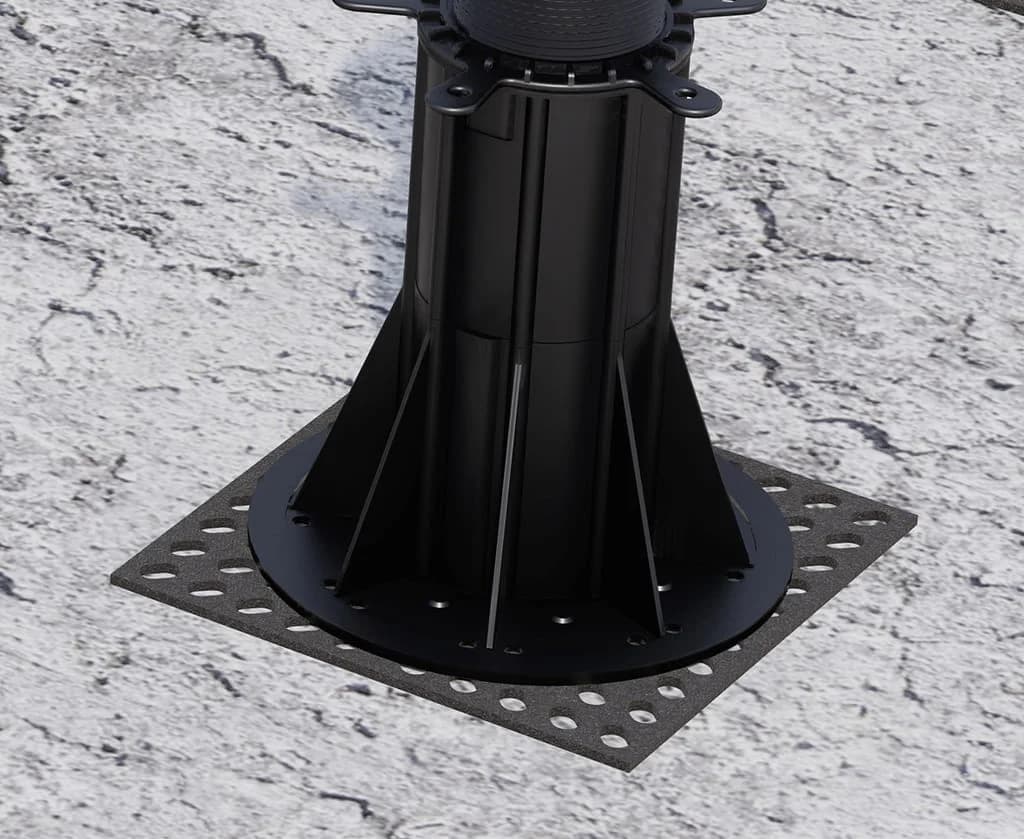
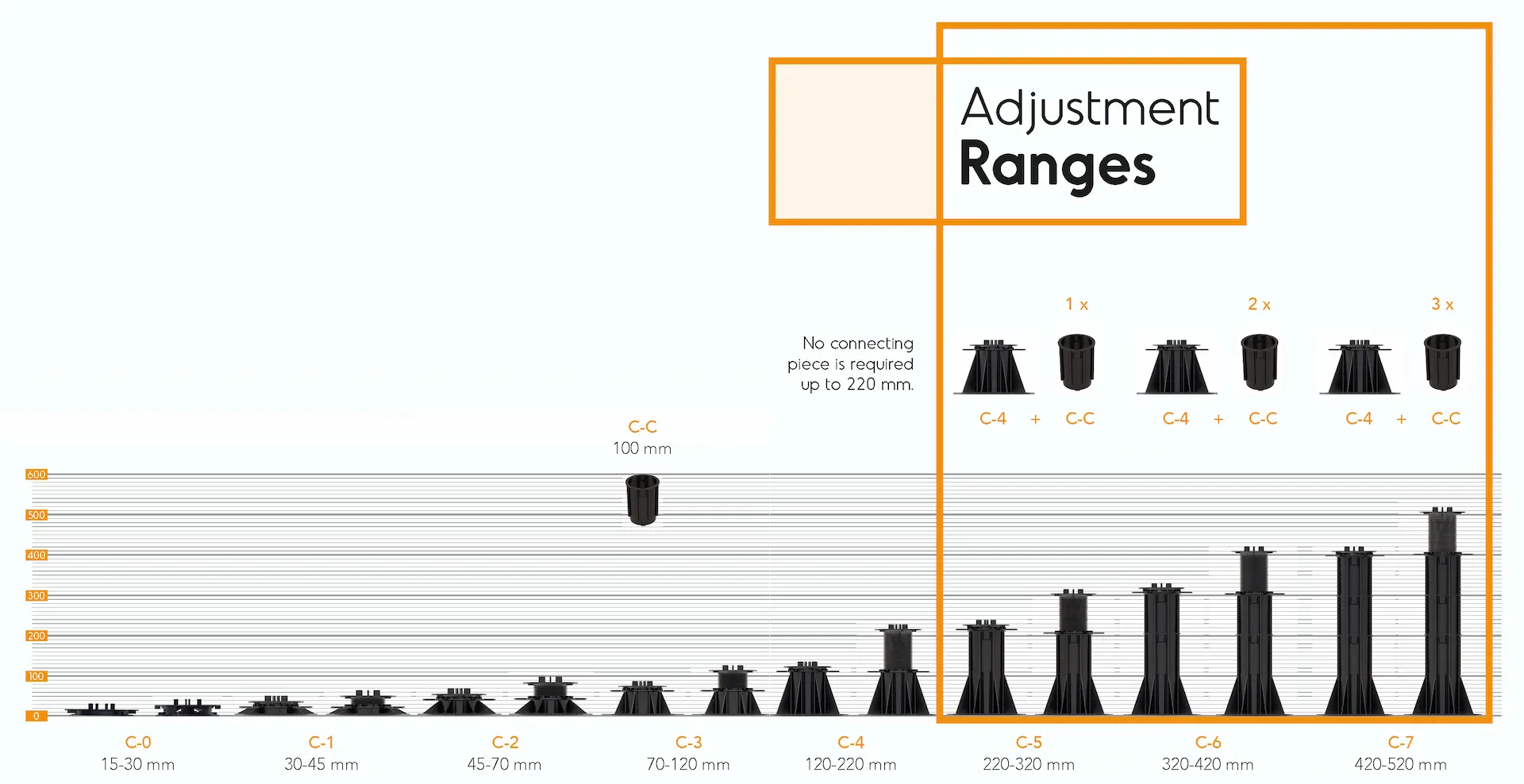
The name Clever is not an abstract body. Clever is a jack. Its height is read by turning the screw of the jack. The declared point is at least 500 kilograms. 500 kilograms is not the weight of the whole terrace. 500 kilograms is the point under one head. The terrace is carried by the number of heads on the layout. Reading the weight of furniture off this number mixes a point with an area. A heavier ask belongs to another jack family. This page does not take that family apart and does not write its rating here. The height band is the chart that shows which jack to choose before the piece is set. The chart lets you pick a band. This text does not turn the millimetres of the bands into an order line. The jack stands on the waterproof sheet or on the slab. No mortar collar is poured around the base. A mortar collar locks the base, and the next removal starts with a hammer. 500 kilograms is a floor of the rating, not a target this paragraph tries to beat. More than one jack can stand under a wide piece. The count is not a guess in this paragraph. The number is read off the setting-out drawing. A spacing is not invented here. The job of the jack is to meet the piece at the same point every time it is set. The meeting is known when the seat of the head takes the piece fully, not by the number of turns on the screw. If the seat does not take it fully, adding turns does not straighten the piece. Seat first, then turns. That order stands beside the 500 kilogram rating. The rating does not replace the seat. The rating names the point that seat carries.
Edge and corner stay on the same body
At the perimeter the jack is not two bodies, one for the edge and one for the corner. Edge and corner are the same piece. That one piece cuts the habit of stacking half bodies around the perimeter and throwing them out. As the field grows, the edge becomes a smaller share of the total count. A corner is the same body turned to two sides. A corner is not a special casting from another mould. Waste here is not a broken tile. Waste is a body left unused in the box. The tile or the batten may be cut to the wall. The jack under it is not cut and called a corner. If the wall is out of square, the piece that is cut is the finish, and the jack stays whole. A jack that stays whole still accepts the slope head and the gasket. Writing an extra percentage of corners on the order is the habit this piece replaces. The percentage habit leaves bodies in the box that were never needed. This section is not the four-way split of the flat edge accessory. That split comes later. What does not split here is the body of the jack itself. Because the body stays whole, the perimeter does not open a second corner family in the catalogue. If a second family is opened, the site counts two boxes and thinks one is short. The box it thinks is short was never required. An unrequired box is waste written into the order from the start. One body carries the same seat all along the perimeter. Because the seat does not change, a piece still lifts at the edge and comes back to the same level. It lifts at the corner too. The rule of lifting does not change between the middle of the field and its perimeter.
C-SL, C-SLH and C-SLB take fall up to 7 percent
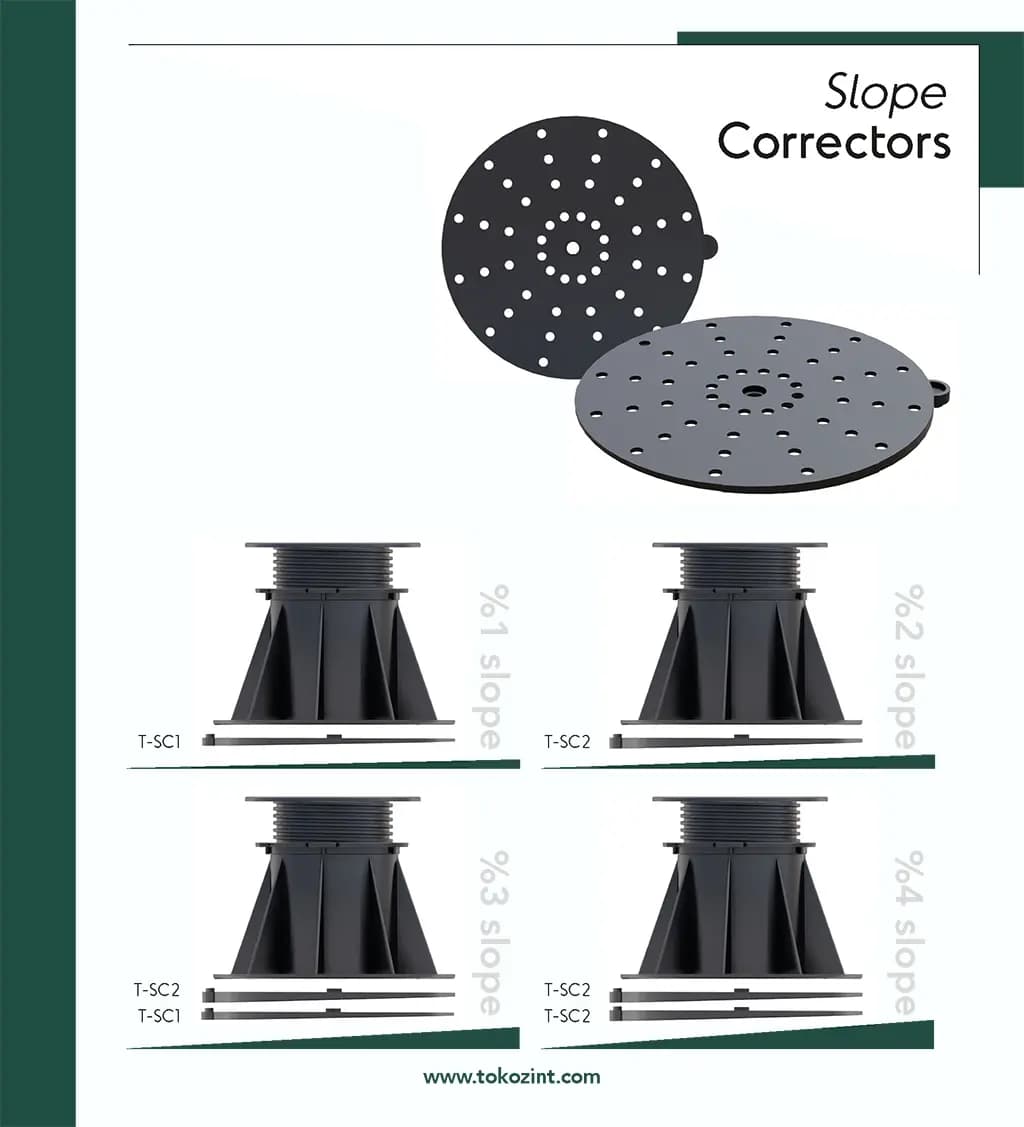
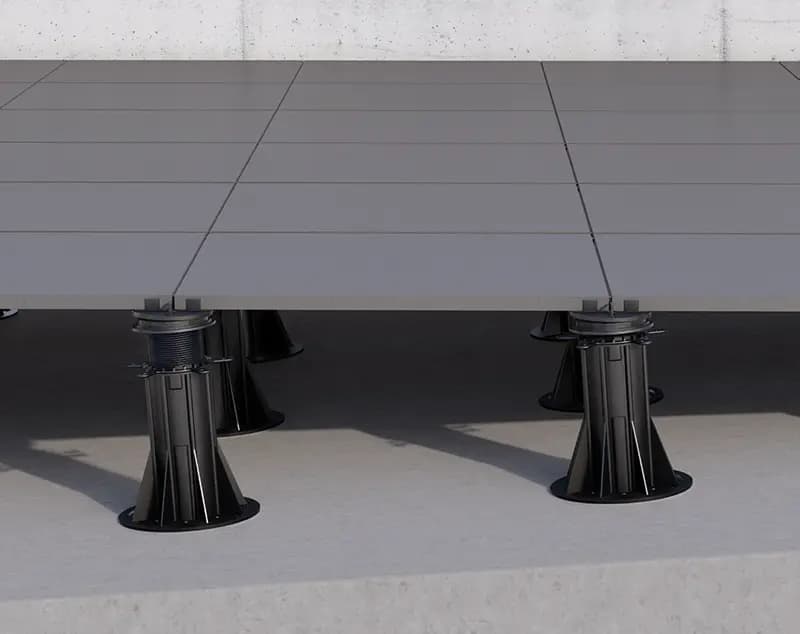
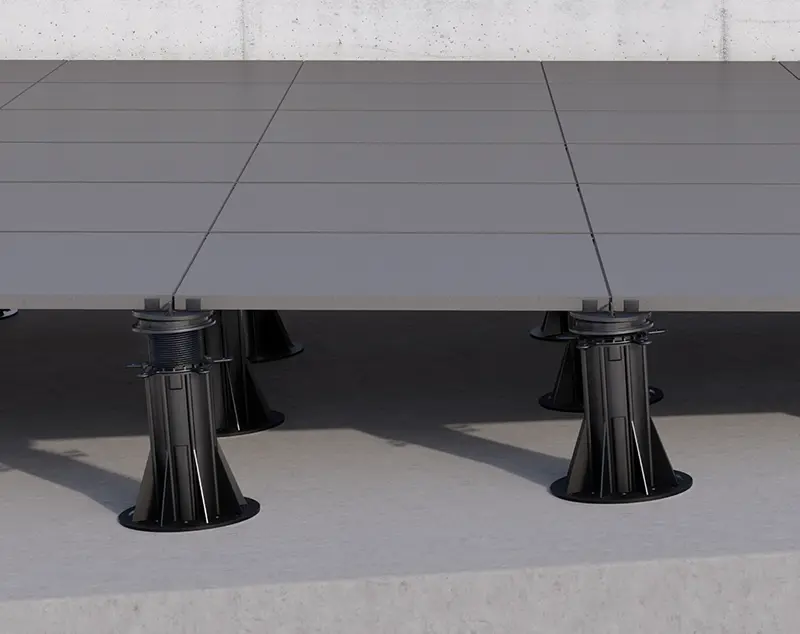
Drainage fall is not stored on top of the piece you walk on. The parts that take the fall are the heads C-SL, C-SLH and C-SLB. These heads correct drainage fall up to 7 percent. 7 percent is the limit of these heads. 7 percent is not a rainfall sum. The head tilts so the jack can stand on a sloping sheet while the piece above is set to the level that is wanted. Each jack can take its own tilt. A jack on the high side of the sheet and a jack on the low side do not pretend the sheet is flat. The difference is taken in the head. The piece still lifts. C-SL, C-SLH and C-SLB are not read as three load classes. The three are the slope-head set for the same job. This text does not invent which code carries which sub-name. The choice is whether the fall fits inside this limit. If the sheet runs the wrong way, the head does not reverse that error inside itself. The direction of the sheet is put right in place first, then the head is set. The frame shows heads standing under loose tiles. The tiles are not stuck. While the head takes the fall, the tile keeps the right to lift. Litres, drain diameter and wind pressure are absent from this section. Their absence is not a missing table. Their absence separates the job of the slope head from a flow sheet. Flow sits at another table. What is written here is the 7 percent limit of the head, and that the piece can be set again above that limit. If the limit is passed, the head is not forced. Forcing leaves the piece tilted and spoils the next setting.
C-S and C-FS are each a TPE gasket
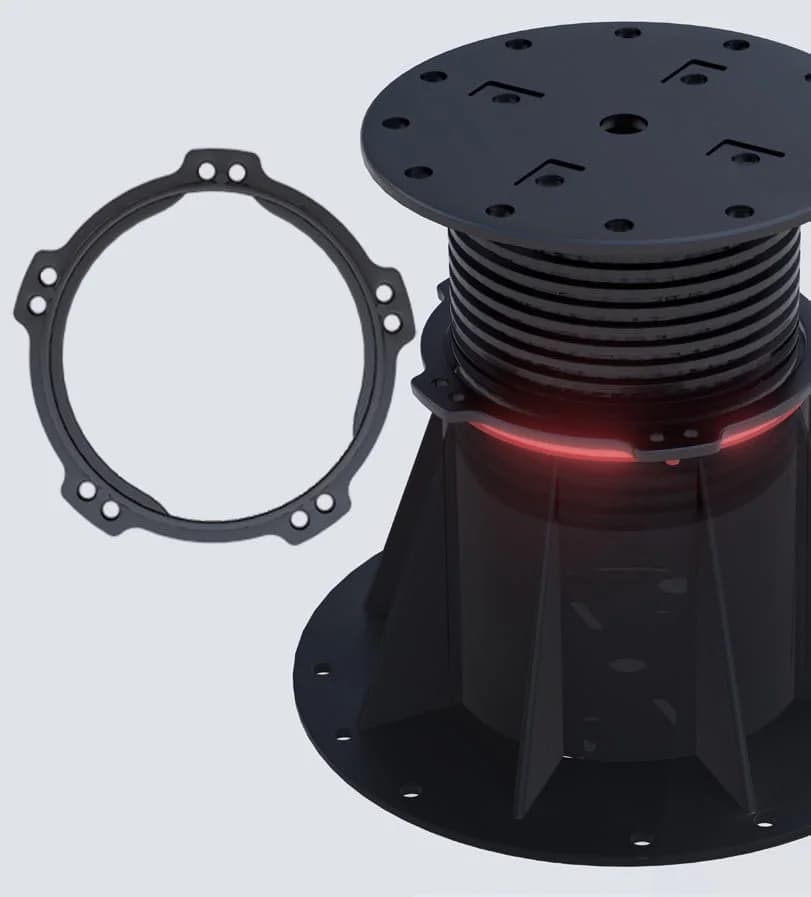
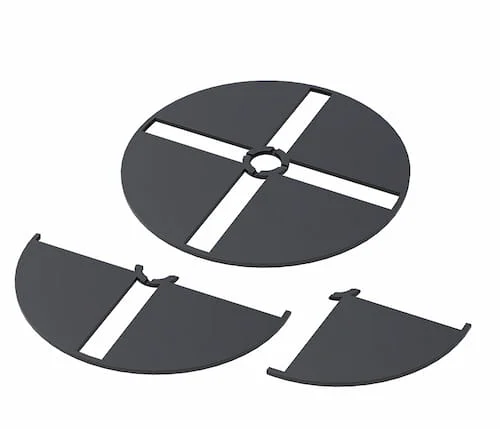
C-S and C-FS are the TPE gaskets in the Clever set. The gasket stands between the finish piece and the head. TPE is the material of the gasket. This text does not write a thickness or a hardness number on the gasket. What the frame shows is a round disk whole and in halves. A half disk is for the edge, where a full disk would hang past the piece. The gasket is not glue. The gasket is the soft layer that stops the piece rubbing the hard head into a noise and into a point bruise. In the product account these gaskets take up vibration. Taking up vibration is not sticking the piece into the seat. A gasket that is glued on stops being a gasket and becomes a bond. A piece that is bonded does not lift. A torn gasket is changed without lifting the whole field. One piece comes up, the disk is swapped, the piece goes back into the same seat. C-S and C-FS are not split in this text into two loads. The two are the names of the TPE pair. The disk in the frame is read from that pair, whole and half. Which name is fixed and which name is free is not invented. An invented split makes the site open the wrong box. The right reading is this. The soft part is TPE, its place is between head and finish, its form is whole or half. The half is not a random tear of the disk to save scrap. The half is the form cut to the edge of the piece. The disk does not take the place of the jack body. The body stays below. The disk is the thin layer above the body and under the piece. If the thin layer is missing, the piece comes down on the hard head and the sitting mark scores the head. The score shows that the gasket was forgotten. A forgotten gasket is not made up by extra turns of the screw.
From C-F0 to C-F4 the edge part splits into four
C-F0, C-F1, C-F2, C-F3 and C-F4 are edge parts. These parts split into four. Splitting into four means a short wall uses a quarter instead of binning a whole strip. Waste is the remainder that is not used. The split is made so the remainder becomes the next part, not so the remainder becomes scrap. This is not the body of the jack. The body stayed whole in the earlier section. What divides is the edge part. Dividing into four is the cut the part is made for. A saw line drawn at random is not the same saving. A part cut at random does not sit in the seat and cannot be counted as a quarter. The four parts stay inside the edge set. A long run uses more of them. A short return uses one quarter. Ordering a full uncut strip for every short return is the waste this split removes. This text does not write a millimetre length on a C-F part. A length is not invented beside the name of the part. The job of the part is to bring the finish at the edge down into the seat of the jack, by the same rule as the middle of the field. A quarter goes into the same seat. If it does not, the quarter was cut wrong or the wrong box was opened. The right quarter leaves the finish able to lift at the edge too. A quarter that is glued at the edge erases the reason for splitting into four. The reason is to cut waste, not to fix the edge. An edge that is fixed becomes a different floor from the piece in the middle. A different floor opens a second talk about level at the sill and at the foot of the parapet. This page does not open that talk. The page says the quarter sits loose as well.
What is asked is a jack count, not a pour volume
What is written on the order is the count of jacks, the count of slope heads, the count of gaskets and the count of edge parts. A volume of screed is not written on the order. Height is not a thickness to be poured. Height is read from the level that must be reached and is chosen in the band of the jack. The number is read off the setting-out drawing. This page sets no price. This page writes no rainfall flow. This page writes no wind pressure. The piece returning to the same seat is the whole reason of the page. The reason is not an anatomy essay that takes a body down to a screw thread. The screw is the means of reading the height. The means does not take the place of the reason. The jack pressed in Çorlu enters the box as the point of this loose floor. The box does not stand in for a sack of bedding mix. What comes out of the box is a whole body at the edge, the C-SL family on the fall, a TPE gasket on the face between, and a C-F quarter on a short return. Those four lines are the lines the site will count. If one of the four is missing, the floor is set short, and a short setting is not closed with glue. Glue hides the missing line and ends the lift. Whoever asks for a quotation sends these four counts together with the area. Area alone does not give the number of jacks. The number is read together with the size of the piece and the returns of the edge. That reading is not tied to a formula in this text. Inventing a formula takes the place of the layout. While the layout is there, the formula stays quiet. What stands beside the quiet formula is the piece that lifts and comes down to the same level. If the piece comes down, the order was read right. If the piece does not come down, the missing line is in the box, not on the site.