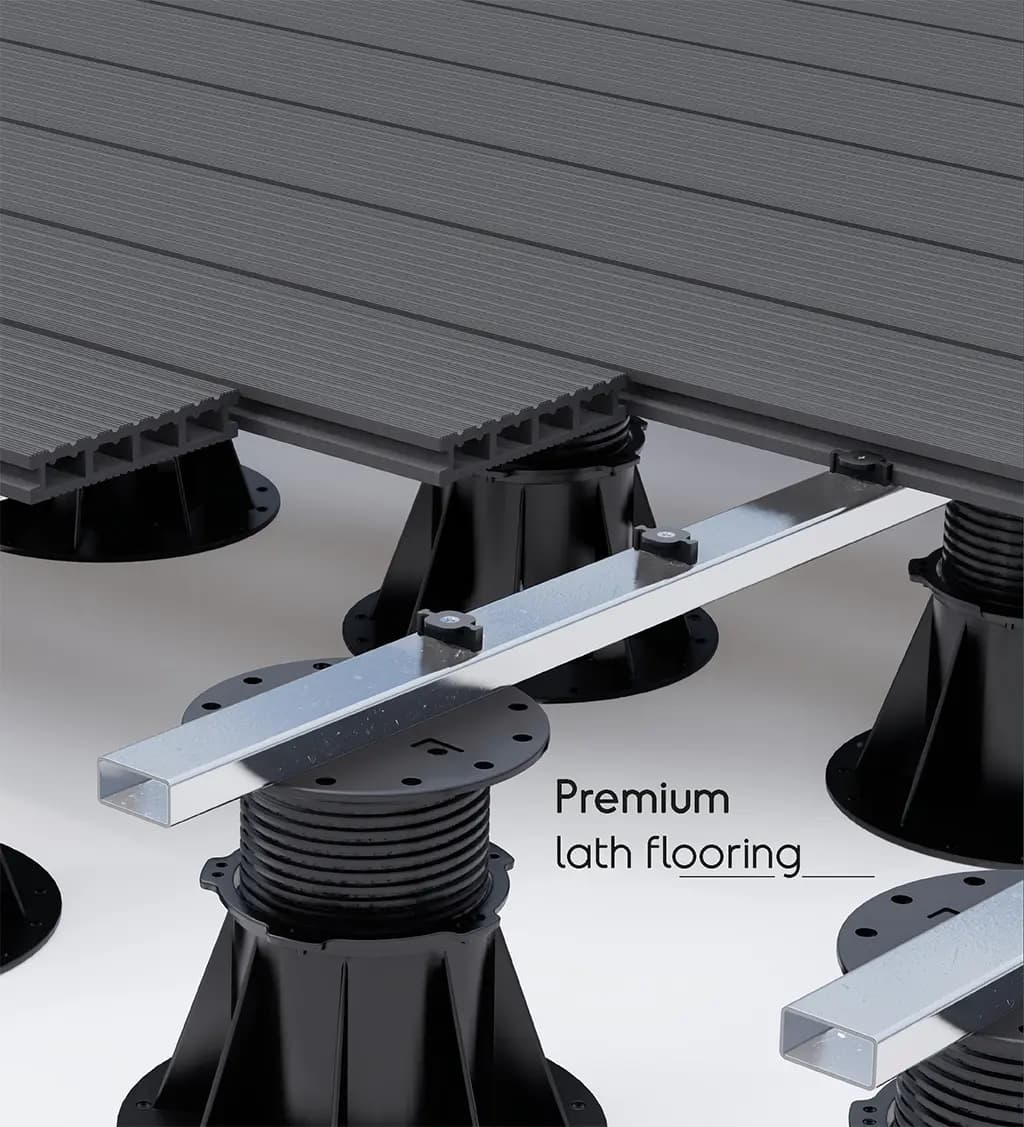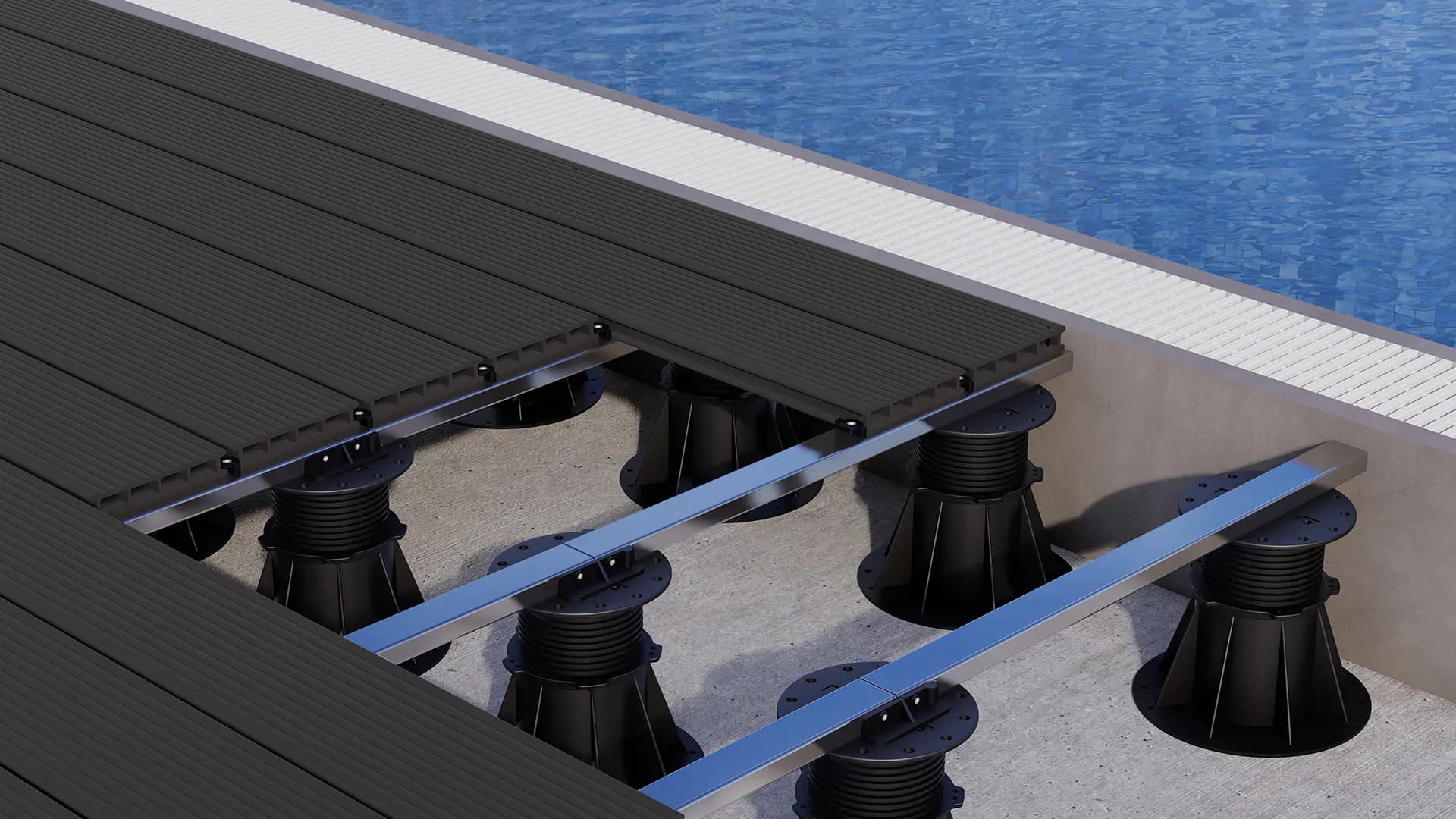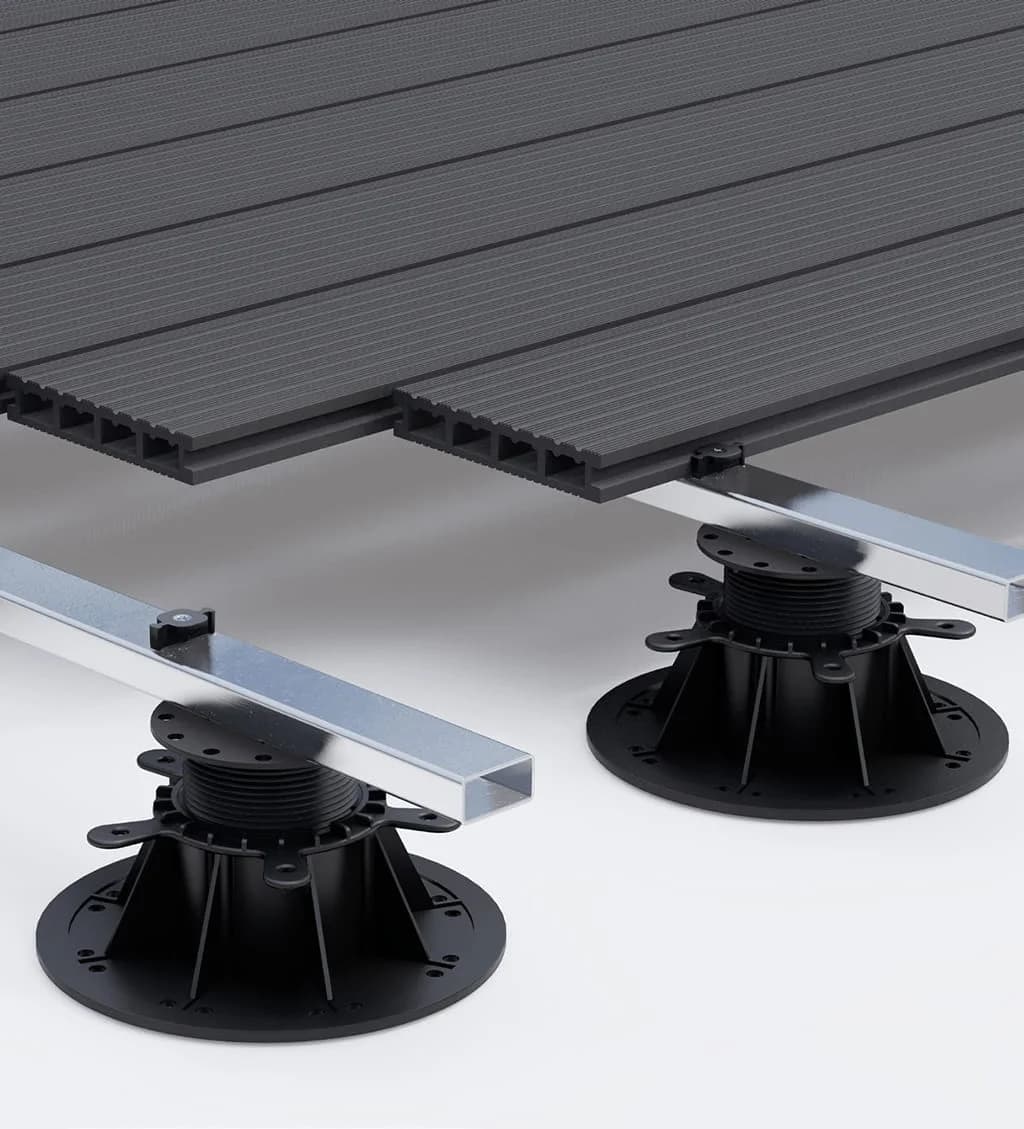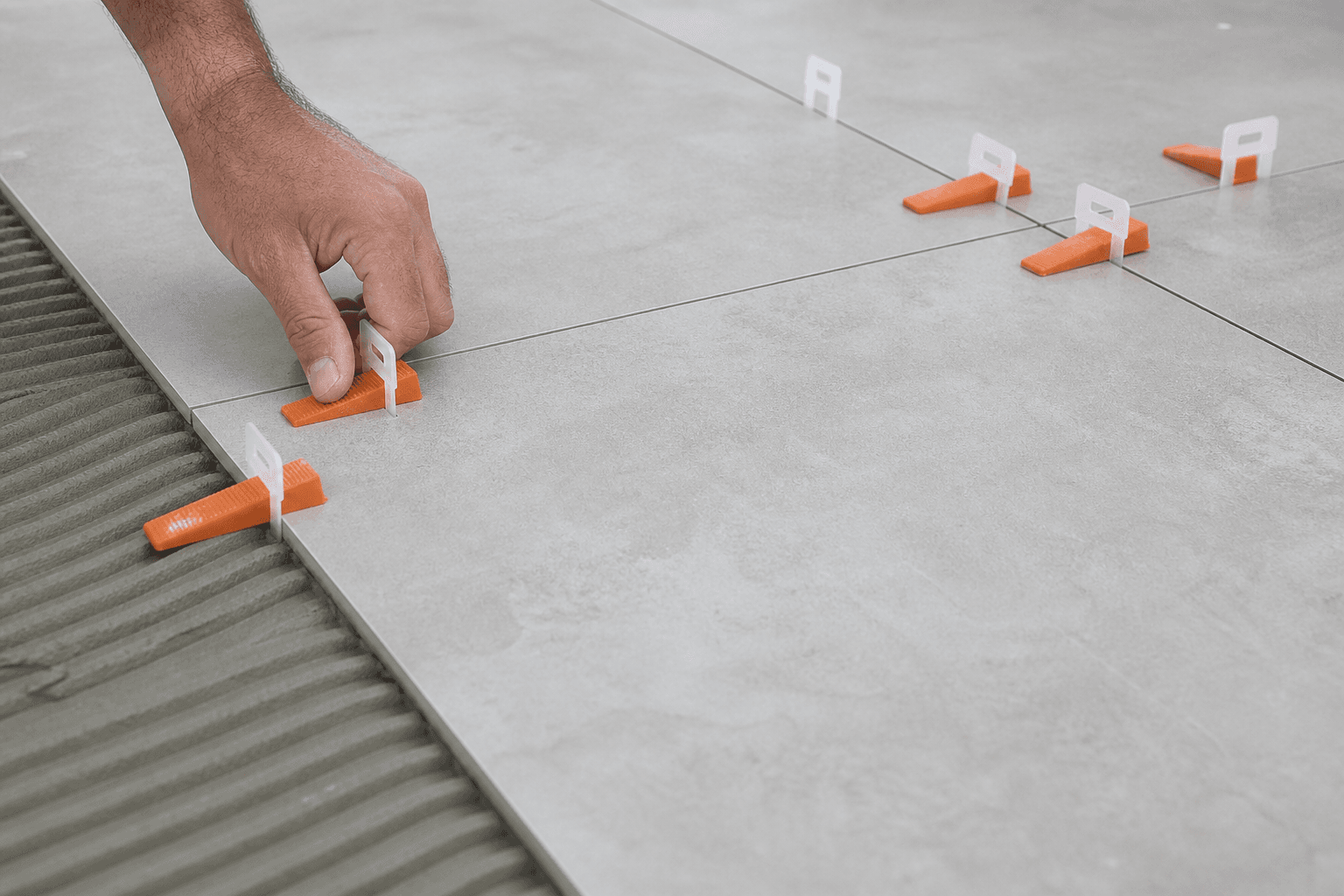
Terrace pedestals are Clever jacks pressed in Çorlu. Half and quarter heads close the parapet line. A corner stays one jack. Wind lock T-UWS is used with T-AFJ when the tile is light.
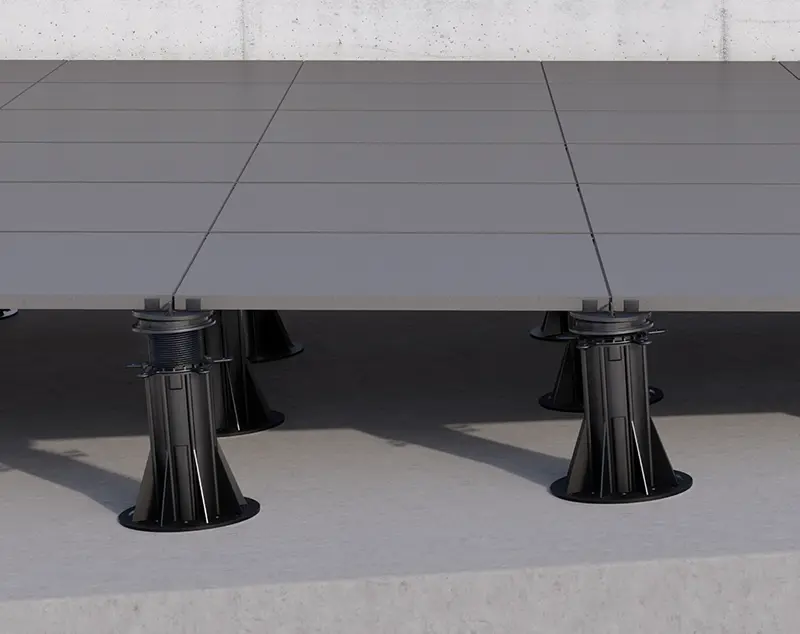
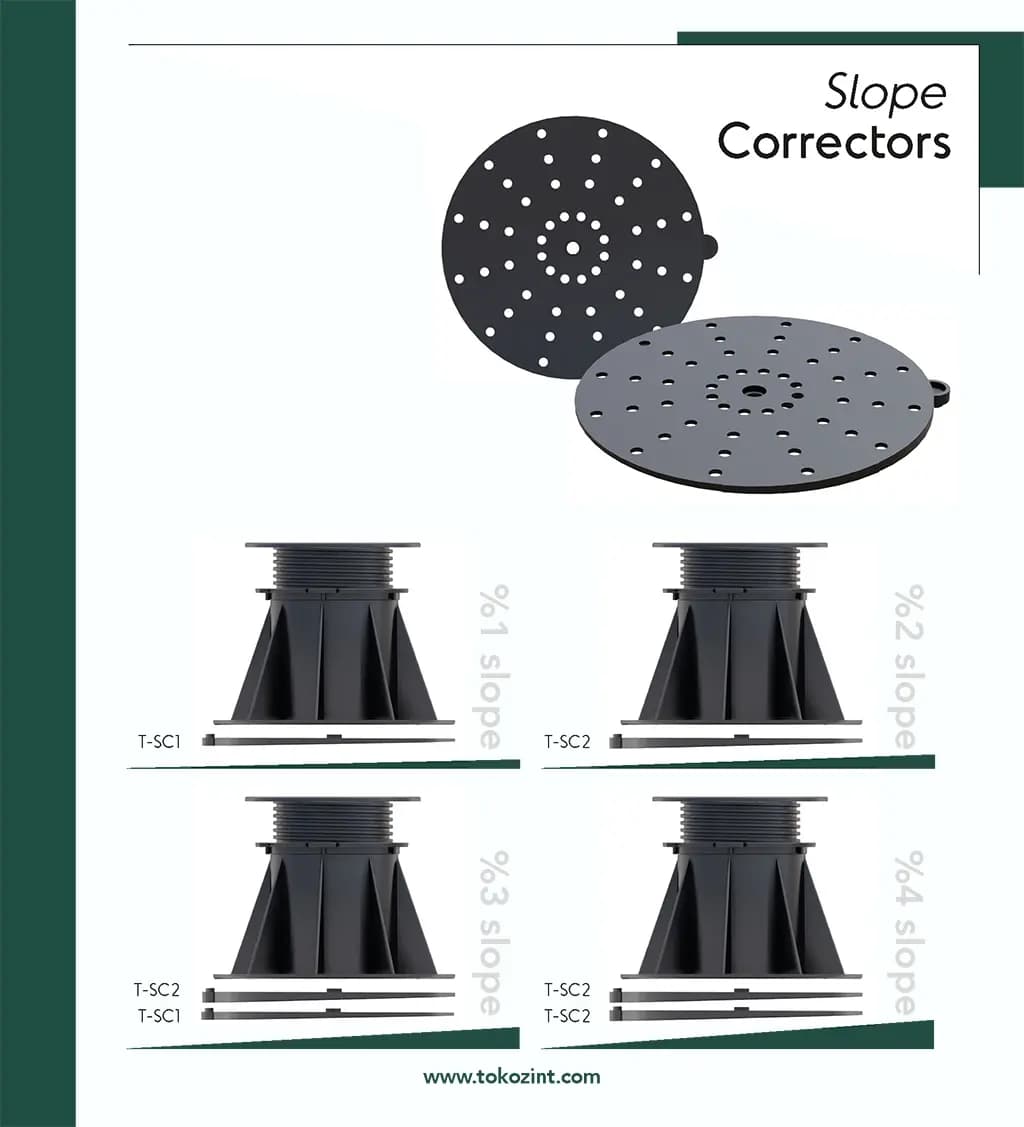
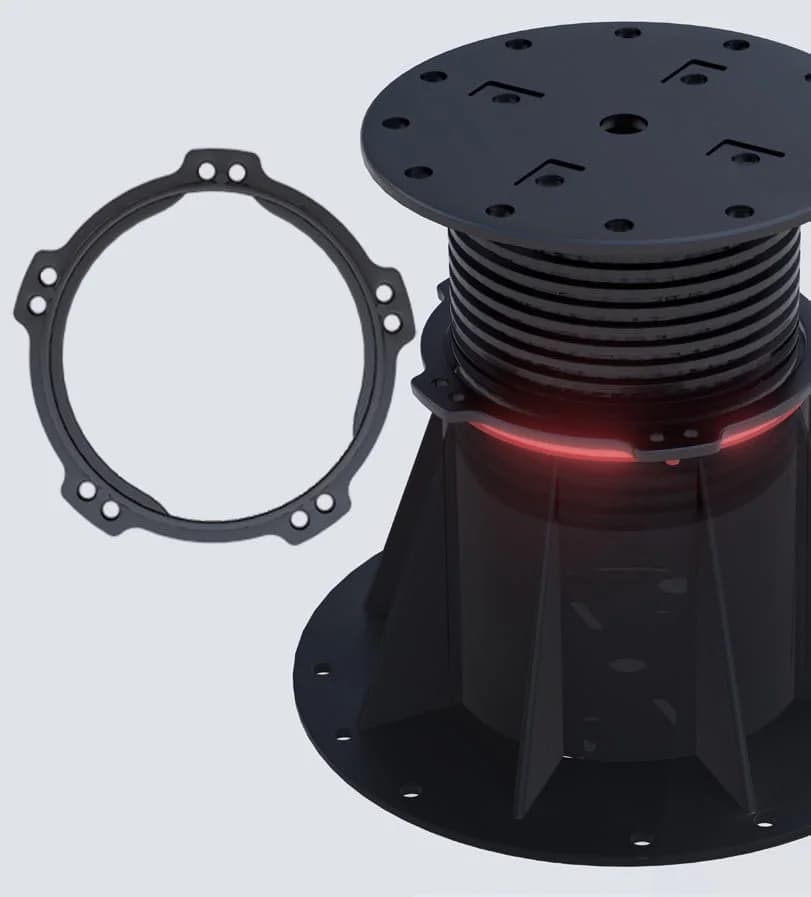
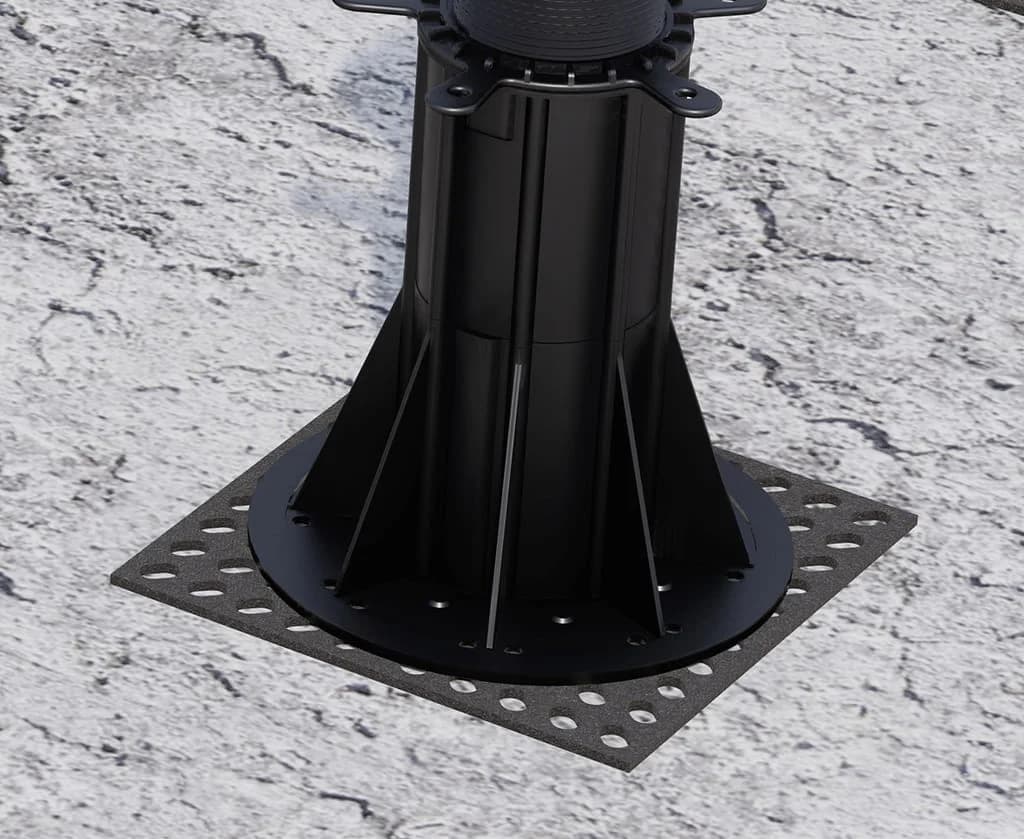
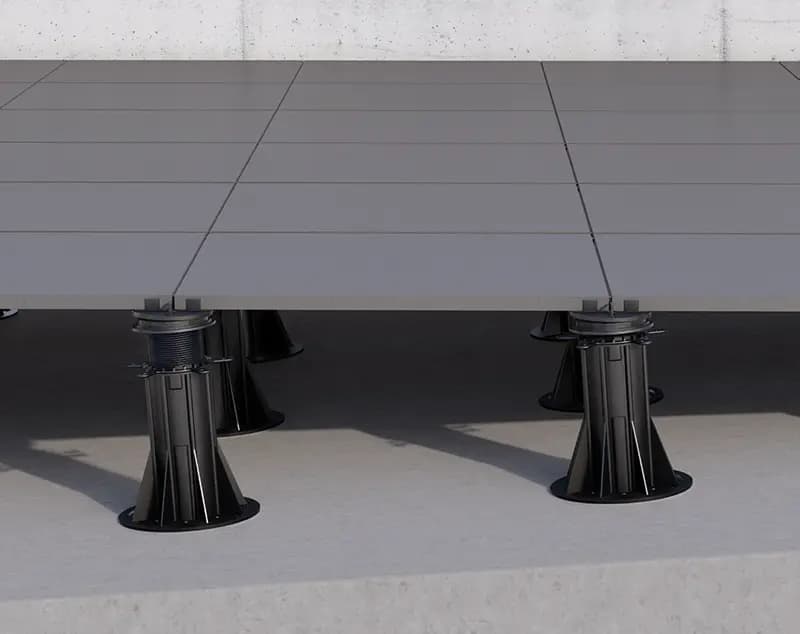
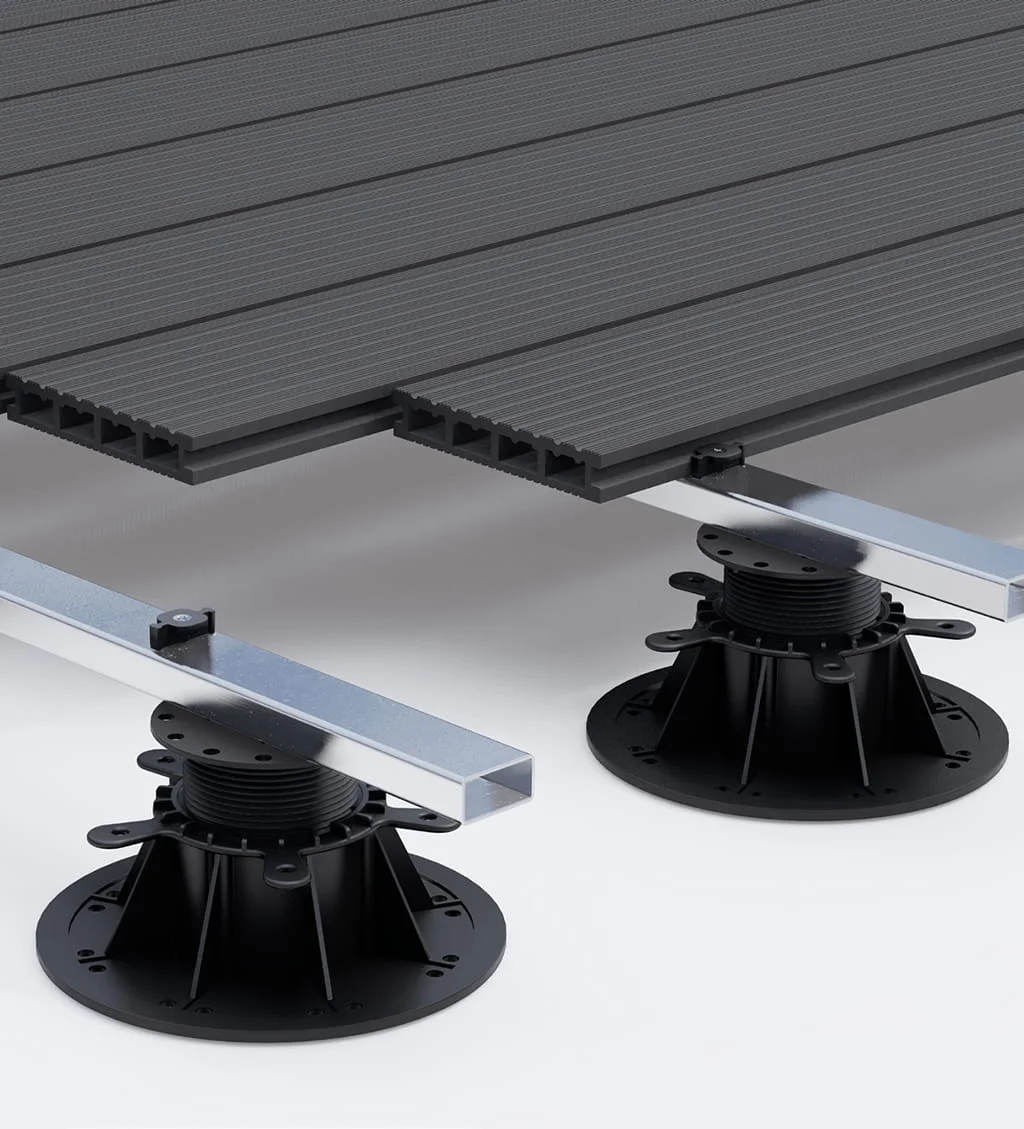
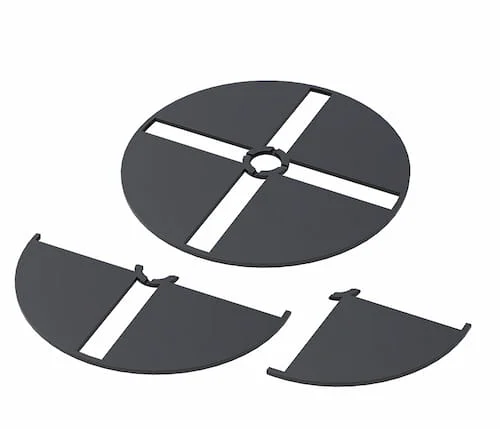
Terrace pedestals are discussed when the last plate has to stop at a parapet. The middle of the field is the same full head repeated, and that repeat is not the question on this page. A plate in the middle bears on four full heads, and the plates beside it hold it in place. A plate on the perimeter has one side open toward the parapet, so the head under that side cannot remain a full head. A delivery of only full heads leaves the last row either hanging or with the head jammed into the wall. Tokoz reads the last row as its own line, set out before the field is counted. On a straight parapet the line closes with a half head. Where two parapets meet, a quarter head on one jack closes both open sides. The body under that head is still a single Clever jack. This page does not describe a cavity under the field, and it does not discuss the material a board is cut from. The slope head in the first frame sits under the plate, and the edge rule stands beside it. The run in the second frame is read from its side. The gasket in the third frame is only a seat. The layout in the fourth frame is there to show how a corner is counted. A reader who came for the centre grid will find the page narrow. The narrowness is deliberate, because the faults that show up on site begin at the parapet. A layout that leaves the parapet until the end can count the full heads in the middle and still miss the edge. A missing edge means there is no piece under the outer corner of the plate. Without that piece the plate either leans on the wall or rocks over empty space. Both are the condition this page is here to close.
A half head takes the straight line, a quarter head takes the corner
A half head carries the outer edge of the plate along a straight parapet. A full head is too much there, because its body runs into the wall and pushes the plate back off the line. A half head is not counted as a full head sawn on site. A saw spoils the seat and does not produce a piece that can be read as a half. On the order the straight run is written as half heads of its own. At a corner two parapets are open at once. A quarter head gives a bearing cut from two directions, and the corner of the plate stands without slipping inward from the wall. A quarter head is not improvised outside the box either. An improvised piece holds the plate one way and lets it escape the other way. The rule, half on the straight run and quarter on the return, is read from the setting-out. That reading is an extra line beside the count of full heads in the middle. If the line is not written, the edge is made do with the middle pieces, and an edge made do tilts the plate. A tilted plate looks as if it is holding water at the foot of the parapet, while the real fault is a head that does not bear. When the head is the right one, the plate stays in its own plane, and the gap to the parapet belongs to a later measurement. This split is not the splitting of an edge part into four. That split belongs to another heading. What is divided here is the face of the head that meets the plate. If the face is right, the plate can still be lifted at the edge. A wrong face works like a wedge that locks the plate to the wall and makes the lift hard. Tokoz presses this face as the half head and the quarter head of the Clever line. Forcing a head from another line into this seat makes the piece you thought was a half behave like a full head.
Wind looks for the plate at the parapet
Wind does not try to lift the field from the middle. Plates in the middle hold one another, and each of them meets a neighbour on four sides. At the parapet the outer edge of the plate is free. That free edge is where the wind tests the plate from below. The test does not start in the middle. It starts at the free end. When the free end rises, the next plate loses its share and the rise walks inward. No figure is written here to stop that walk. This page does not give a wind pressure. What it gives is the name of the place: the parapet. If the place is known, the lock can be put in the right place too. Putting the lock only in the middle of the field and leaving the parapet bare leaves empty the point where the wind begins. Saying that a heavy plate will stay by its own mass is not a calculation of this paragraph either. There is no calculation, because this text is not a load table. The text points at the free edge of a light plate. The point explains why the lock named in the next heading is asked for the last row, not for a middle row. Even when the head of the last row is a half or a quarter, a light plate can still rise off that head. The head carries. It does not by itself stop the rise. Stopping the rise is the lock's work, and the lock faces the edge of the plate that faces the parapet. Laying the same lock extra on a middle plate does not fill the lack at the parapet. The lack is not a small count. It is the wrong place. Raising the count before the place is put right leaves locks in the box and leaves the plate open on the roof.
T-UWS with T-AFJ on a light tile
On a light tile the wind lock is T-UWS, and it is used together with T-AFJ. The pair comes to the free edge at the parapet. The pair does not take the place of a half head. The half head carries the plate. The lock holds a light plate from rising off that carrier. T-AFJ is the piece that lets the lock fasten to the jack. The lock is not left loose on top of the plate. A piece left loose walks with the wind and does not count as holding the edge. This page writes no pressure value on the lock. What is written is the name of the piece and its place. The place is the last row. If the last row is straight, the lock stands beside the half head. If the last row is a corner, it stands beside the quarter head. The lock is added after the head is chosen. It is not added earlier as a shopping line. A lock written early as a shopping line goes to the wrong run. On the Clever line a light tile asks for this pair. A guess that a heavy stone will stand on its own does not make the pair unnecessary, because a guess is not a table. There is no table in this text. If one exists elsewhere, it is not copied onto this page. When the lock comes off, the plate can rise again. That rise does not mean the edge rule has failed. It means the lock was opened for a visit. After the visit the same pair comes back down beside the same head. As it comes down, the place where T-AFJ fastens to the jack is checked. If there is no fastening, the lock was only standing on the plate, and that is not the work the pair describes.
C-F parts make the offcut smaller
C-F0, C-F1, C-F2, C-F3 and C-F4 are the edge parts of the Clever line. These parts split, so on a short return a whole strip is not thrown away and the offcut stays smaller. The split is the part's own division. A saw line drawn at random does not do the same work. A piece cut at random does not sit in its seat and cannot be counted as a small offcut. What splits is not the body of the jack. The body stays whole. What splits is the edge set. A long parapet uses more pieces from the set. A short return carries the smaller remainder on to the next edge. Asking for an uncut full strip for every short return brings back the offcut this division is there to shorten. This text does not write a millimetre length on a C-F part. A length is not added beside the name. The job of the part is to bring the plate at the edge down into the seat of the jack. That bringing down is the edge version of the rule used in the middle of the field. A half head is a head. A split C-F part is an edge part. They are not two names for one moulding. On the order they stand on separate lines. If they are joined on one line, the site is left either without a head or walking to the parapet with a head and no edge part. The name C-F1 looks close to the name CP-F1 on the Premium line. Looking close is not being the same family. This heading counts only the Clever edge set. A part from the other family is kept apart under the next heading. The small offcut exists so it can become the piece for the next short return. It does not exist to be sorted into the bin as scrap.
A corner does not ask for a second jack
The Clever jack carries at least 500 kg and is one piece at the edge. Being one piece means you do not add a second jack because the drawing shows a corner. The quarter head goes on that one jack. If two jacks are set at the corner, the plate sits between two bearings and the line breaks. A broken line pushes the plate inward from the parapet or leaves the corner empty. 500 kg is the stated lower limit of the jack. That figure is not a wind load and it is not a price. This page writes no price. The figure is there to say that the jack at the corner carries the same stated limit. The corner is not a special weak piece that lowers the statement. What is taken for weakness is often the plate pinched by a second jack. A pinched plate will not lift, and the edge rule looks as if it has failed. The rule has not failed. The rule was not applied as a quarter head on one jack. The consumption layout therefore shows the corner as one point. A habit that splits the point in two inflates the count on the layout. An inflated count looks like more jacks in the field and leaves a pair standing in the wrong place at the edge. On a straight parapet the same body continues with a half head. A separate family of bodies is not opened for the straight run. If it is opened, the site mixes two boxes. A mixed box takes a full head to the corner. A full head meets the wall at the corner and drives the plate inward. Setting another jack beside it to stop that drive grows the drive a second time. The right stance is one body and the quarter head that fits it.
CP-F1 does not ride a Clever line
CP-F1 is the edge support of the Premium family. It is not an edge part of the Clever line. Its name looks like C-F1, and that likeness is the source of the mix-up. The mix-up starts when CP-F1 is set on a Clever jack. If the seat is forced, the part does not enter fully and the plate is left open on one side. The open side is the place a half head is meant to close. CP-F1 does not close that place on Clever. On a Premium module it is a separate support that travels one way and carries a small cut tile on that line. On the Clever line the same job is done by the C-F set together with the half head and the quarter head. Joining the two families on one parapet is an attempt to make one bearing fit two mouldings. The attempt is not made with a shop spacer. A shop spacer is not written on this page as a remedy. The remedy is to look at the family of the part named on the drawing. If the drawing says CP-F1, the line under it is Premium. If the drawing says a part from C-F0 through C-F4, the line is Clever. The two names do not stand on the same order line. If they do, the store sees one box and the site sees another jack. The mismatch that shows does not mean the edge part is damaged. It means the part was carried to a line it does not belong to. The carried part is taken back and the line's own edge set is put in. Once the set is in, the plate comes down on the head of that line. Filing another line's support until it sits spoils both the support and the head. A spoiled pair will not match the next spare either.
Parapet clearance is measured before the last row
Parapet clearance is measured before the last row of plates is set. The measure is the opening from the face of the parapet to the line where the last plate must stop. If the row is set first, the plate hides the opening and the half head is either pinched or left short. A pinched head meets the wall. A short head leaves the outer edge of the plate with nothing under it. Both come from taking the measure too late. The clearance is not guessed by looking at the middle. The pace of the middle grid does not give the opening at the foot of the parapet. The opening is read in place, at the foot of the parapet. A door threshold does not stand in for this measure. The threshold is another level. This measure is only with the parapet. When the clearance is known, the last jack and the half head or quarter head that fits it are set to that opening. After the head is set, the plate comes down. If the order is reversed, the plate is cut twice. The first cut is made before the opening is seen. The second cut shortens the plate once the head is pinched. Both cuts tire the edge and grow the offcut. The offcut that the C-F parts made smaller grows again when the order is wrong. The right order keeps the offcut small. If the opening changes after the measure, what changed is the foot of the parapet, not the middle of the plate. If there is a change, the last jack is moved and the jacks in the middle stay where they are. Disturbing the middle does not correct the edge clearance. The clearance is the last row's own job. When the job is done, the plate stands without leaning on the parapet and without rocking over empty space. That standing is not the subject of a text about a cavity. That standing means the edge has closed.