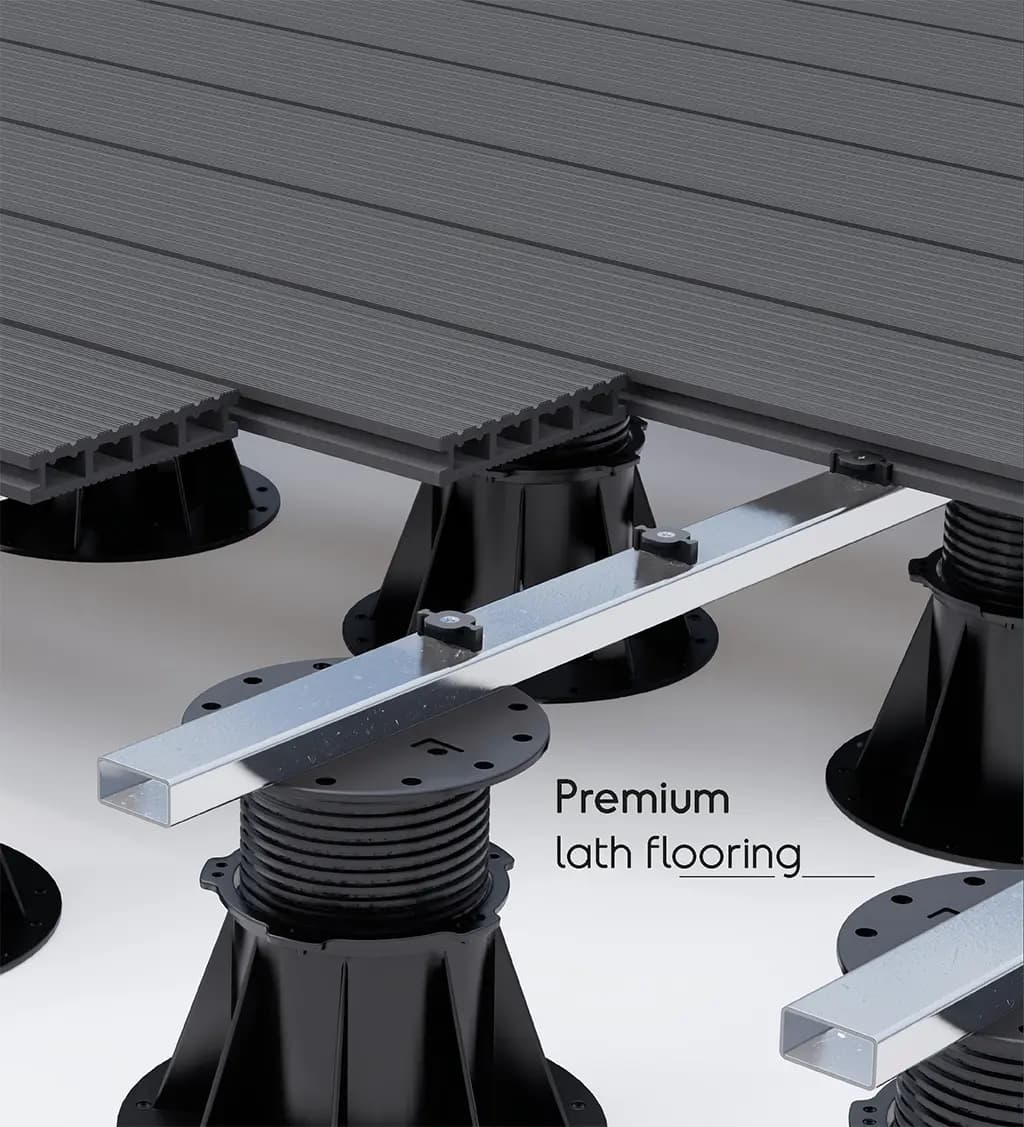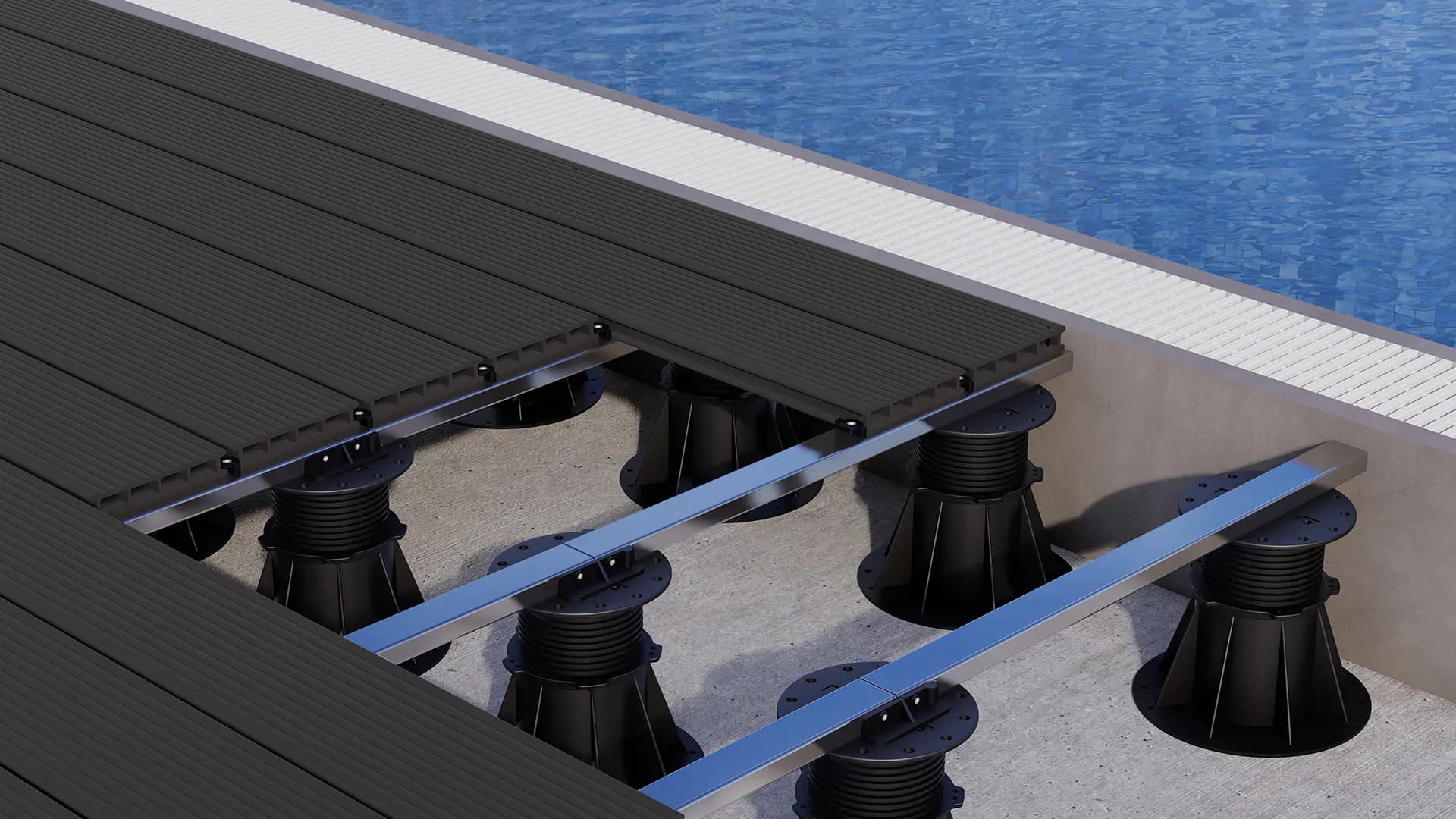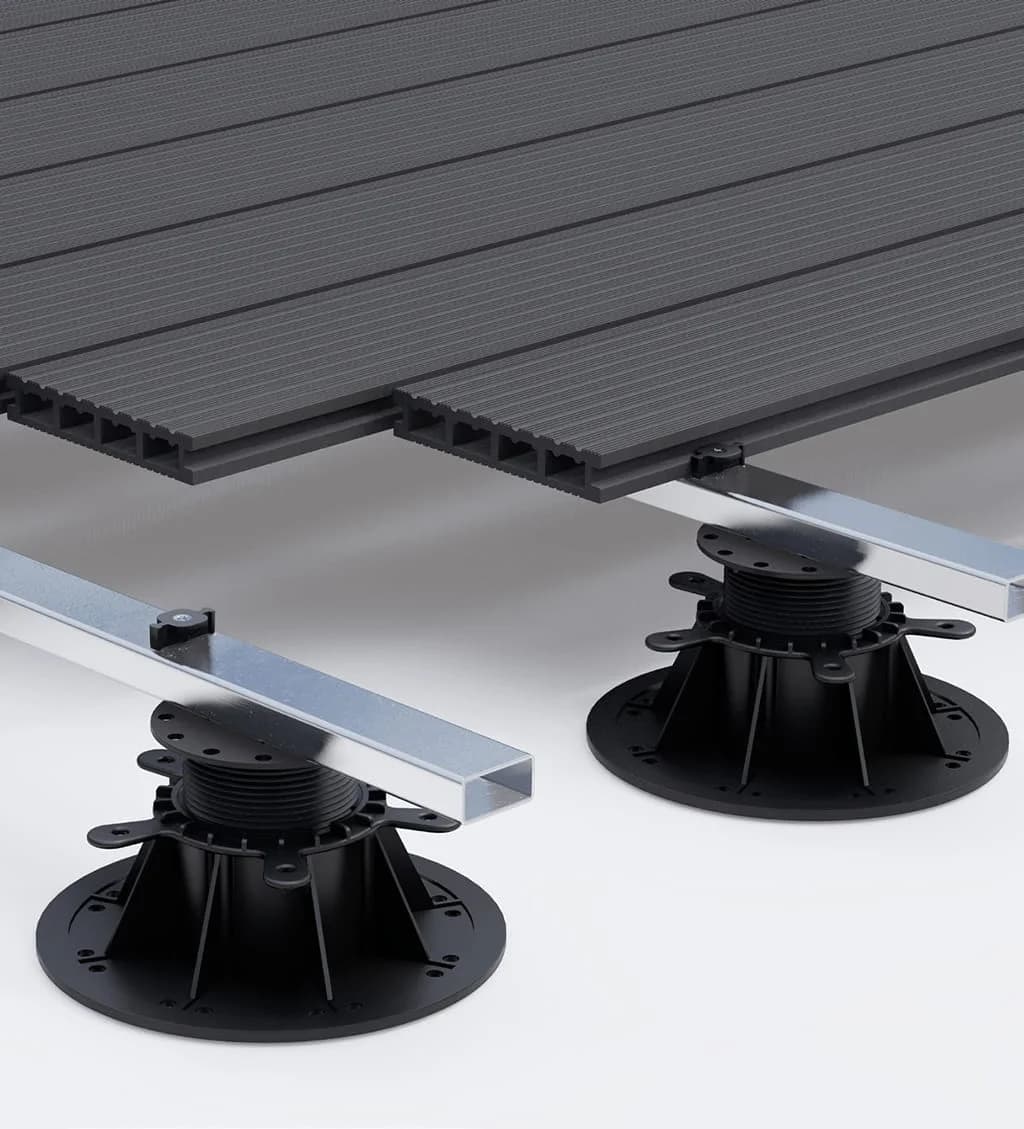
A roof-terrace pedestal is the Tokoz module pressed in Çorlu. It stands on the membrane and leaves its load as points on the roof slab. There is no protective screed to break when a leak is traced.
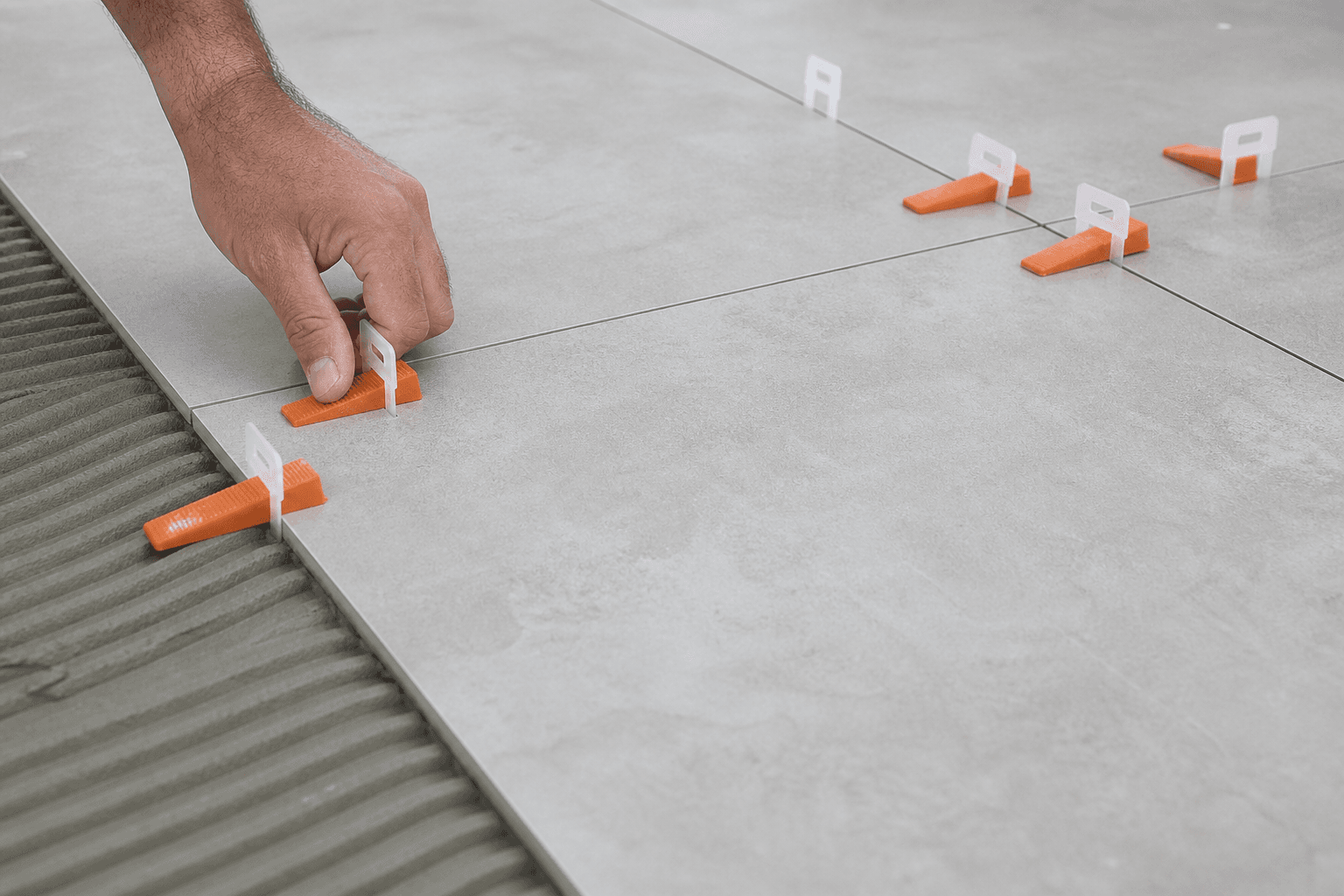
A roof terrace is the walking level people want when the slab beneath them is a roof. Under that slab there is a room, a corridor, or the open well of the building, not a bed of garden soil. Because there is no soil in the detail, the load cannot be told as a wide footing pressed into the earth. It has to arrive on the structural slab. The waterproof sheet on that slab is what keeps the rooms below dry, so the walking plane stands on the sheet and leaves it continuous. The door onto the terrace has a threshold, and the walking plane has to meet it. The parapet has a top, and the same plane has to stay below that top. The sheet already falls toward the outlets, and that fall remains the path the water uses. Naming a module before those three marks agree only postpones the argument to the site. Standing in the doorway and reading the threshold, the parapet, and the low point of the sheet together is the first job. This page stays with that roof. It does not split a module into a catalogue of pieces, and it does not open the recipe of a composite board. The photographs show the pad, the tile plane, the module that is turned, and the piece that takes fall at the base. A garden path is another day. Here the thing underneath is a ceiling, not earth.
The sheet stays unpierced
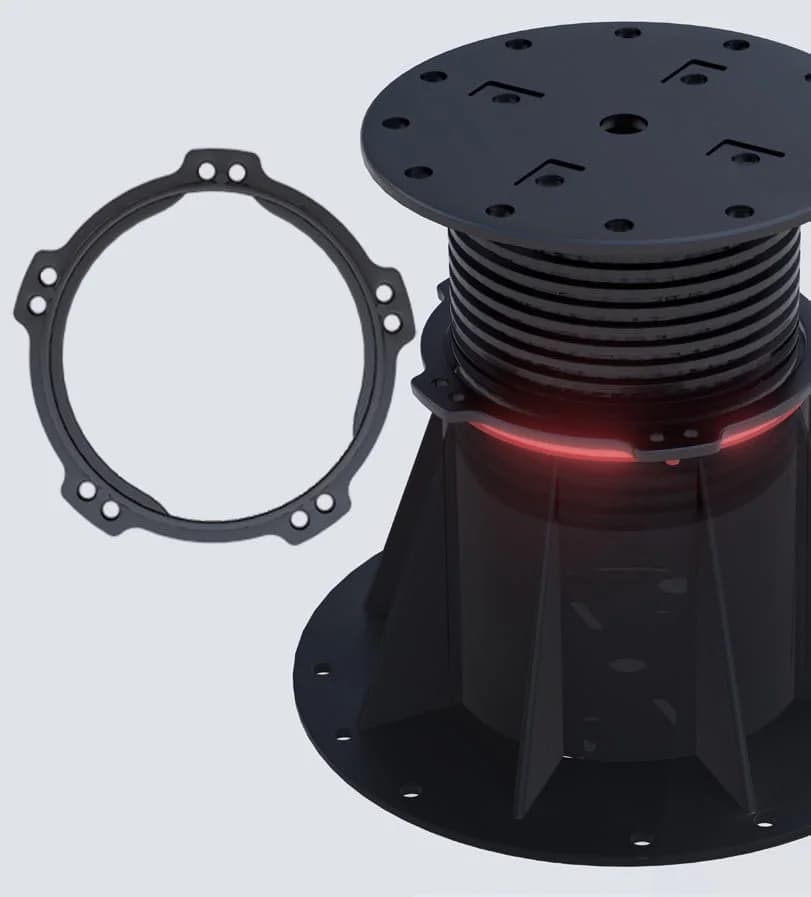
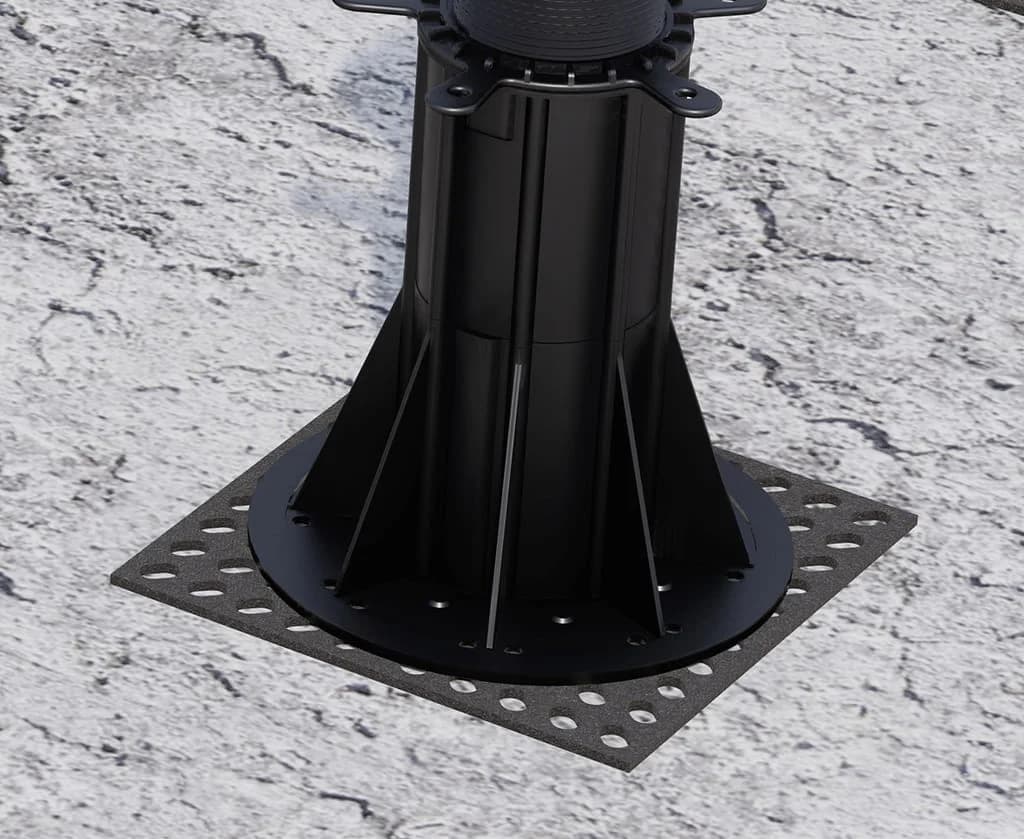
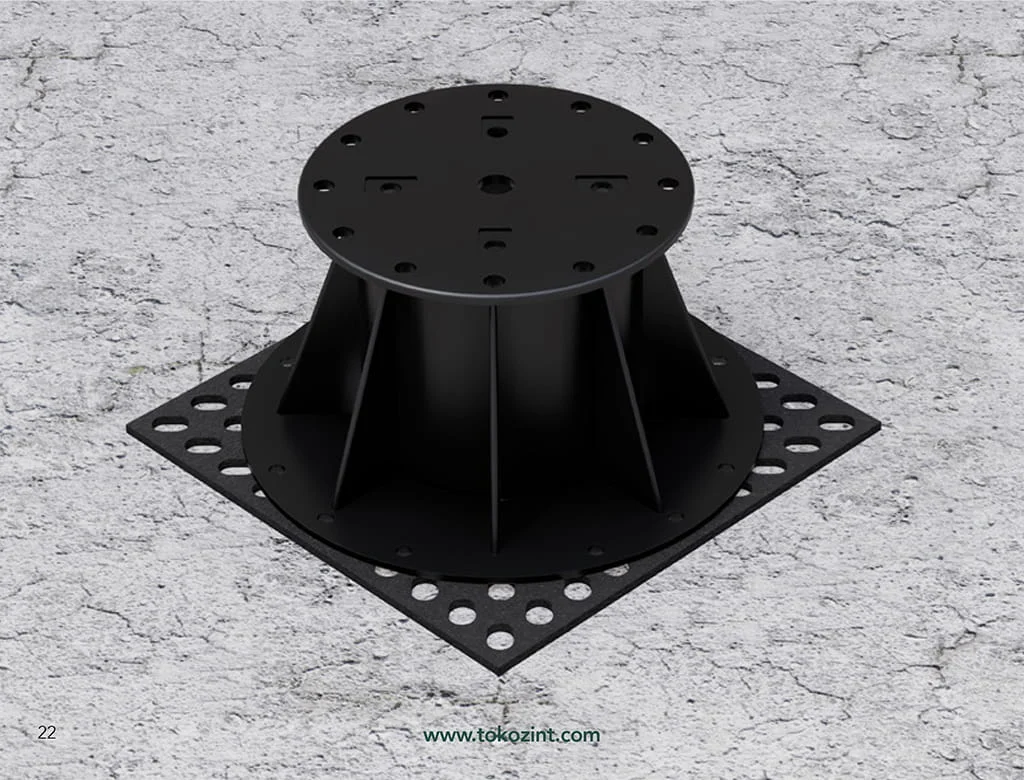
The module stands on the sheet. No screw, stud, or blade passes through the sheet. A hole opened over a room is a water path the roof will not forget. T-P in the photograph is the face where the foot meets the sheet. The pad stops the plastic from biting the sheet on a small bump. Taking the pad away and pressing the plastic straight onto the sheet changes the bearing that was declared. When the pad wears, the piece that is renewed is the pad. The module is not thrown away for that reason alone. This frame is not an exploded view. What the frame says is that the sheet stays whole. A hand at the place where the module will stand looks for a cut, a bolt, or a scar that a later pad would hide. If the scar is there, the sheet is repaired before any foot is set. The foot is not read as an anchor that grips the sheet. Reading it as an anchor turns the roof into a ceiling full of holes. Water goes through the hole into the room and the stain stays on the ceiling. The stain is news a pad cannot cover. The sheet is looked at before that news arrives. The sheet that is looked at is the real roof under the walking level.
The load arrives as points on the slab
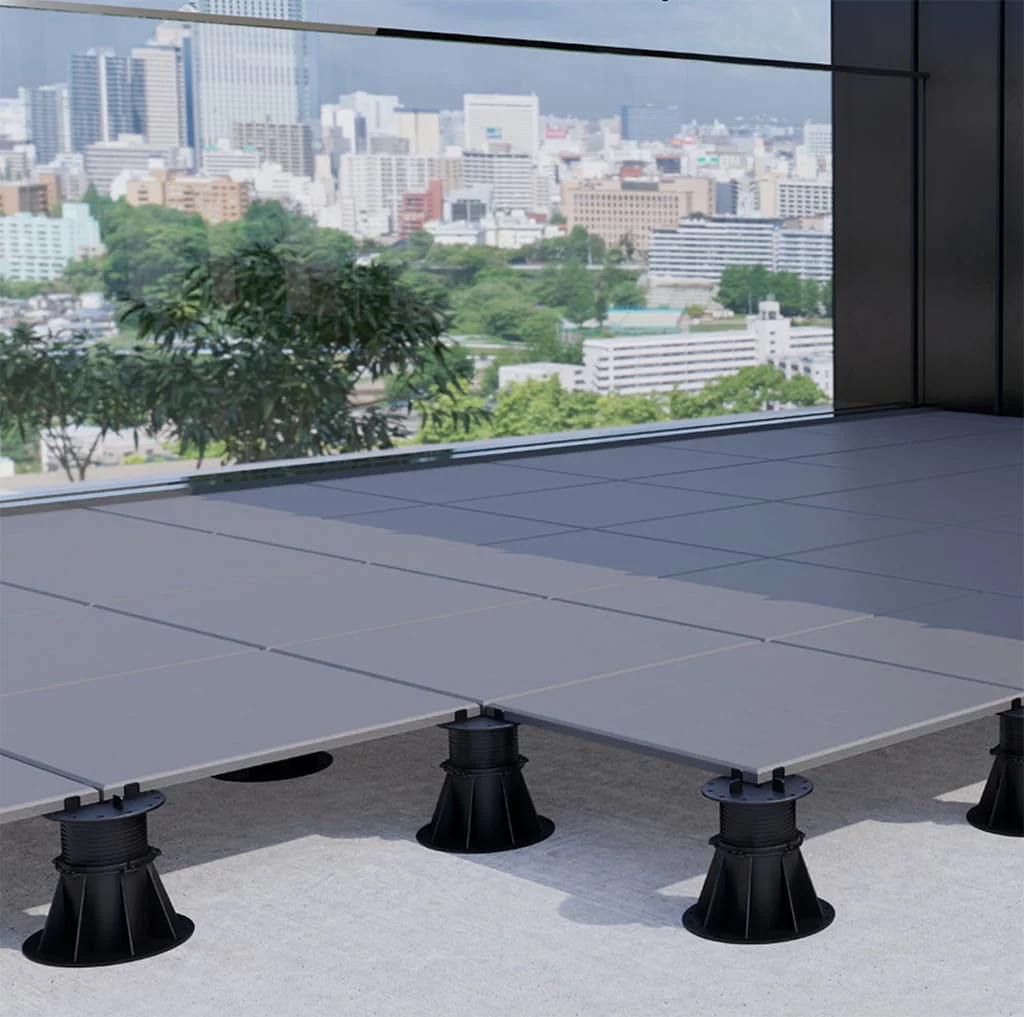
A Premium module is declared at a point load of at least one thousand kilograms for that module. The number is not the weight of the terrace. It is not the tile. It is not the parapet. The roof slab receives a pattern of such points. The pattern is counted from the layout. Placing another capacity beside it on the same plane produces a step at the edge of a tile. The step looks like a bad adjustment. It is two declarations side by side. One order states one capacity. There is no soil-bearing figure on this roof, because there is no soil. A footing spread in the earth belongs to another kind of building. Here the story is the points the slab sees. The points are marked on the drawing. Their count is the order. One mark is one module, not the whole terrace. The declaration of the module does not stand in for the hold at the edge. That hold is another line, and this section opens no pressure calculation. An empty corner on the drawing is not read as a gap to be filled later with mortar. The corner is either a point or a deliberate gap. Which one it is gets written on the plan. A point that is not on the plan is not guessed into place on site.
The walking plane stays level while the sheet falls
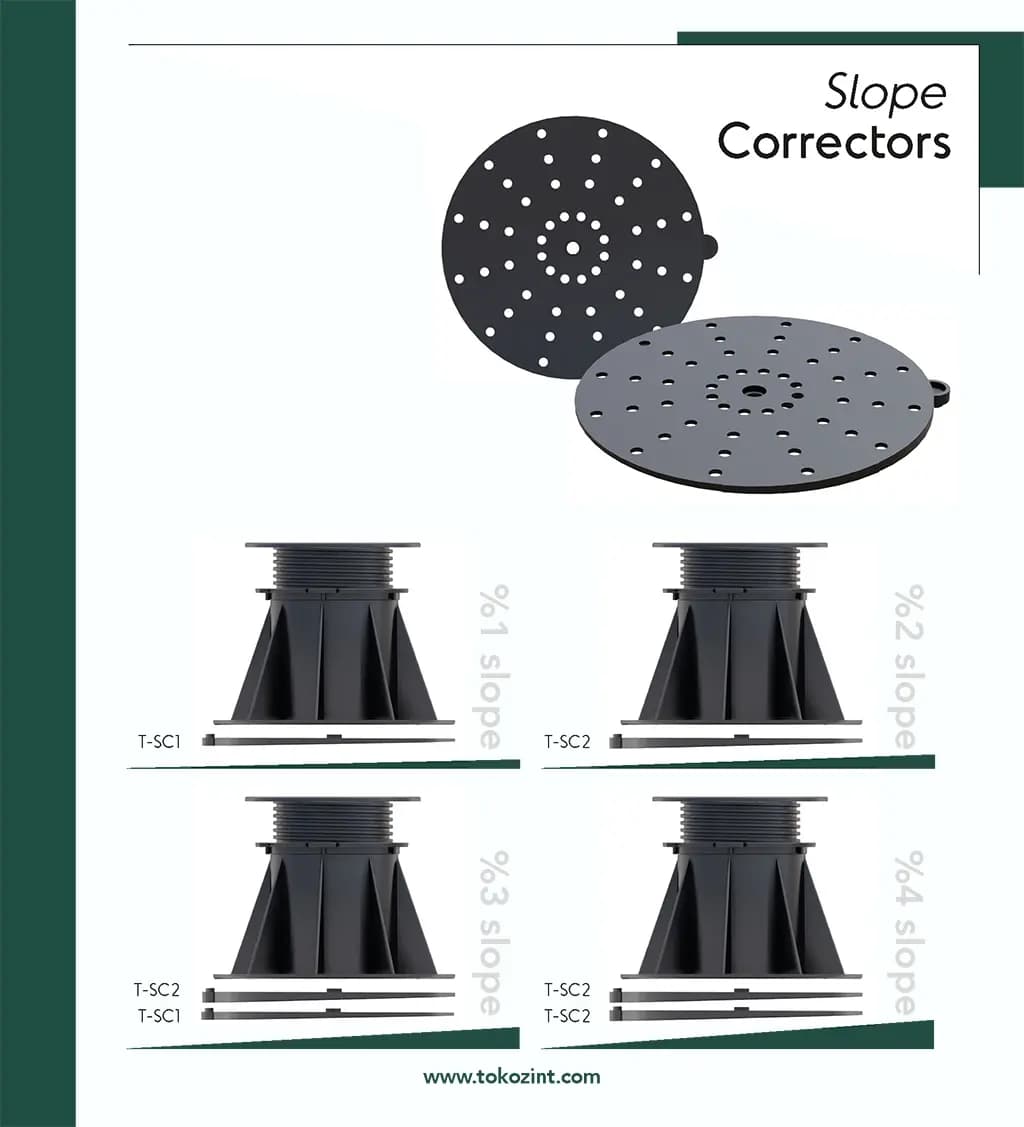
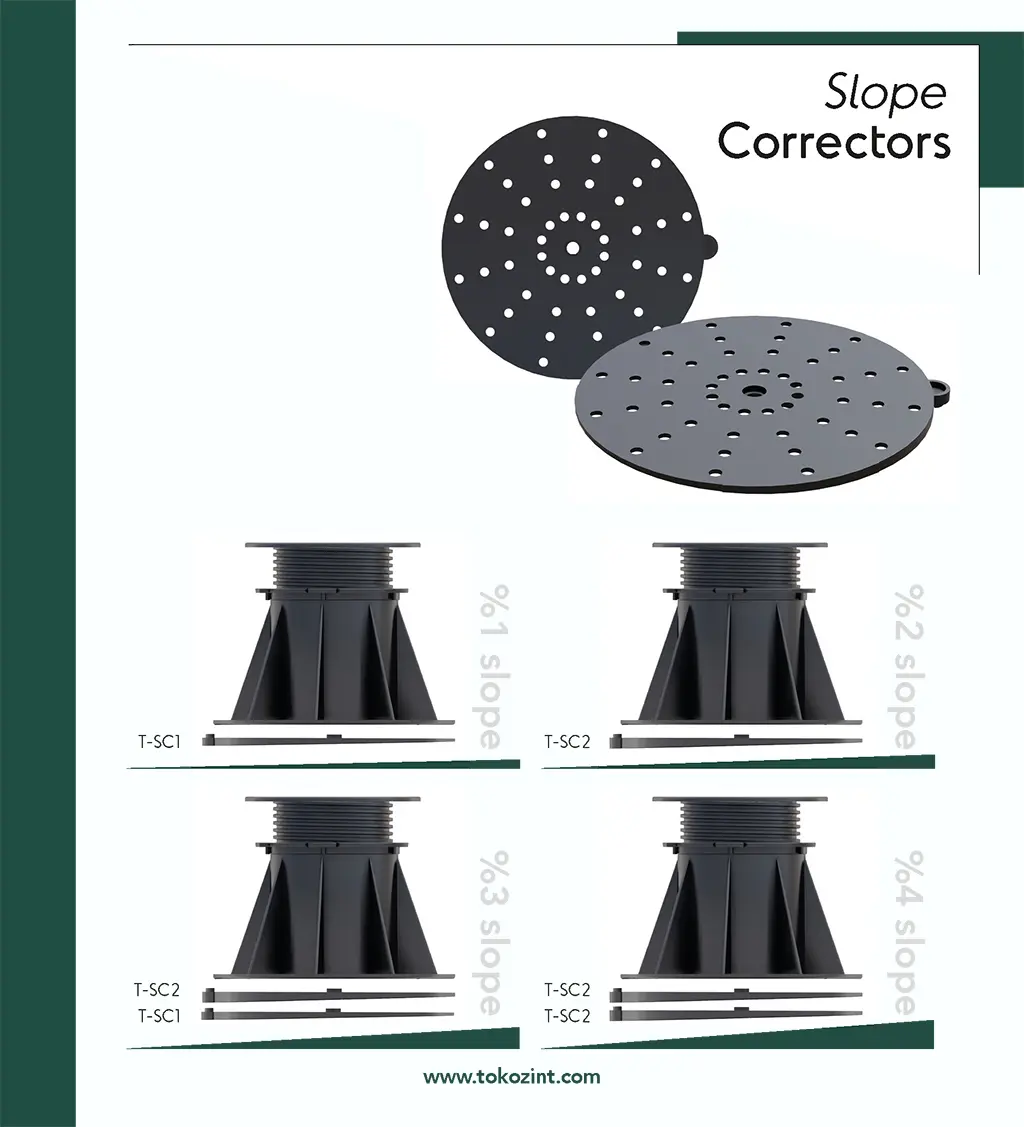
The walking plane wants to sit level. The sheet wants to keep its fall so it can carry water. Forcing both into one plane either ponds water on the tiles or tilts the tiles. T-SC takes that difference at the base. The range in the catalogue is one to two percent. That range is not a rainfall flow. Each module takes its own difference. Two neighbouring screws can show different lengths. The difference does not mean the terrace is twisted. The short screw stands on the high part of the sheet. The long screw stands in the hollow. The meaning is this. The tiles are one plane, and the sheet is not. Water is not sent running across the tiles. It drops between them onto the sheet and follows the fall of the sheet. This sentence does not open a rainfall calculation. No rainfall amount is written on the page. A level held on the tiles agrees with the tiles. The sheet does not have to agree with the level. Putting the slope piece inside the tile erases that split. The piece stays at the base. If an outlet falls the wrong way, the piece does not reverse that inside itself. The direction of the sheet is put right in place first. Then the module sits. The module that sits takes the difference of the sheet without breaking the flatness of the tile.
Wind starts at the edge
The first place the wind tries to lift is the edge. The wind gets under the finish first on the parapet side. A tile in the middle of the field is not the first piece to leave. The edge hold is a line of its own, apart from the point-load line. The point load declared for the module is not written in place of that hold. This page does not calculate a wind pressure. There is no pressure number on the page. The perimeter is walked, and the edge the wind meets first is seen. The hold is written on that edge. A hold written in the middle does not stop the edge that wants to become a wing. Even with the edge held, one tile can still come up when the hold at that tile is released. The hold is not a bed that glues the field down. A glued bed ends the search for a stain. Fear of wind is not turned into mortar for that reason. The fear is written as an edge line. The edge line and the load line sit side by side on the same sheet and do not take each other’s name. At a corner two edges meet. The corner is where two holds meet. The meeting is not an excuse to drill an anchor hole in the middle. A hole would pierce the sheet again. The edge piece stays above the sheet. The piece that stays above holds the tile in place without closing the gap the wind would use as a story of pressure.
A leak is looked for at that point
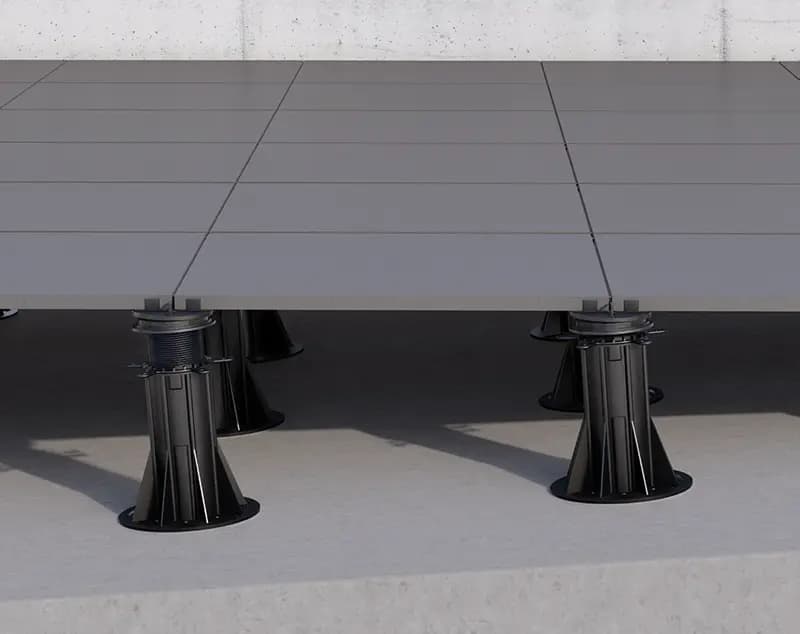
A leak shows in the room below as a stain on the ceiling. You go up and lift the tile above that point. A protective screed is not broken, because this roof has no protective screed. Under the lifted tile the sheet, the fall, and whatever sits in the space are visible. The neighbouring tiles stay down. When the repair is finished the same tile comes back down on the same module. If the module has moved, the fall of the water is looked at again by eye. This page does not write a laboratory watertightness test. The work is possible because an empty gap remains under the tile. If the gap is full of mortar, the stain cannot be read from under the tile. A stain that cannot be read invites breaking the whole terrace. The invitation is refused. One tile comes up, the stain is discussed, the tile goes down. The discussion carries the place of the stain in the room onto the plan of the terrace. The mark on the plan shows which tile to lift. If the wrong tile is lifted, the stain is still on the ceiling and the right point is looked for one tile over. The search does not require rolling the field up like a carpet. Rolling it up cancels the reason for the gap. The reason is that the point can be opened. When the opened point is closed, no new hole is made in the sheet. A point that closes without a new hole shows that the roof still stands by this method.
This roof has no protective screed
A protective screed is the layer poured on the sheet that the finish bonds to. This roof terrace does not have that layer. The absence is not a missing line. It is the method. Pour the concrete and the gap closes, the tile will not lift, the water disappears inside the concrete, and the slab carries an extra weight over the room. The module is not a fill put in place of that concrete. The module is the point that keeps the gap open. Air stays between the points. Setting modules later on a roof that already has a screed does not build this terrace. It builds a second height on top of the screed. If that second height is wanted, the door and the parapet are measured again. The threshold may no longer be enough. The railing may come out short. If it is not wanted, the screed is outside this page. The day a stain shows on the ceiling, the question is what will be broken. If the answer is concrete, the method has changed. If the answer is one tile, the method is still standing. A volume of screed is not a line of the order. The line of the order is the number of modules and the gap that will stay above the sheet. An offer that closes the gap with screed turns the roof into another job. The turned job ties the search for a stain to breaking concrete. A search tied that way is not the roof this page describes.
The order is read from the roof plan
The order is read from the roof plan. The lines are these. The height that meets the threshold and stays under the parapet. The number of modules. The slope piece where the sheet falls. The edge hold as a line of its own. This page writes no price. It writes no rainfall amount. It writes no wind pressure. The modules for this roof are pressed in Çorlu. The count comes from the layout, not from the smallest box in a catalogue. The order is not an anatomy of pieces. The lines the roof asks for are the lines that are written. If a line is missing, the missing line is not closed by pouring concrete on the sheet. A missing line is not finished by guessing on site. A guess misses the threshold or leaves the edge empty. An empty edge is the first place the wind will try. The height is measured with the door leaf open. A level read from a shut leaf can rub when the leaf opens. The rub shows that the module has come out short. A short module is not corrected by cutting the tile. Cutting the tile does not repair the level. The level is read by turning the module. After the turning is finished, the tile plane is set beside the threshold. A plane that does not sit beside it is the wrong height line of the order. The right line is written on the plan, and a price is still not written on this page.